


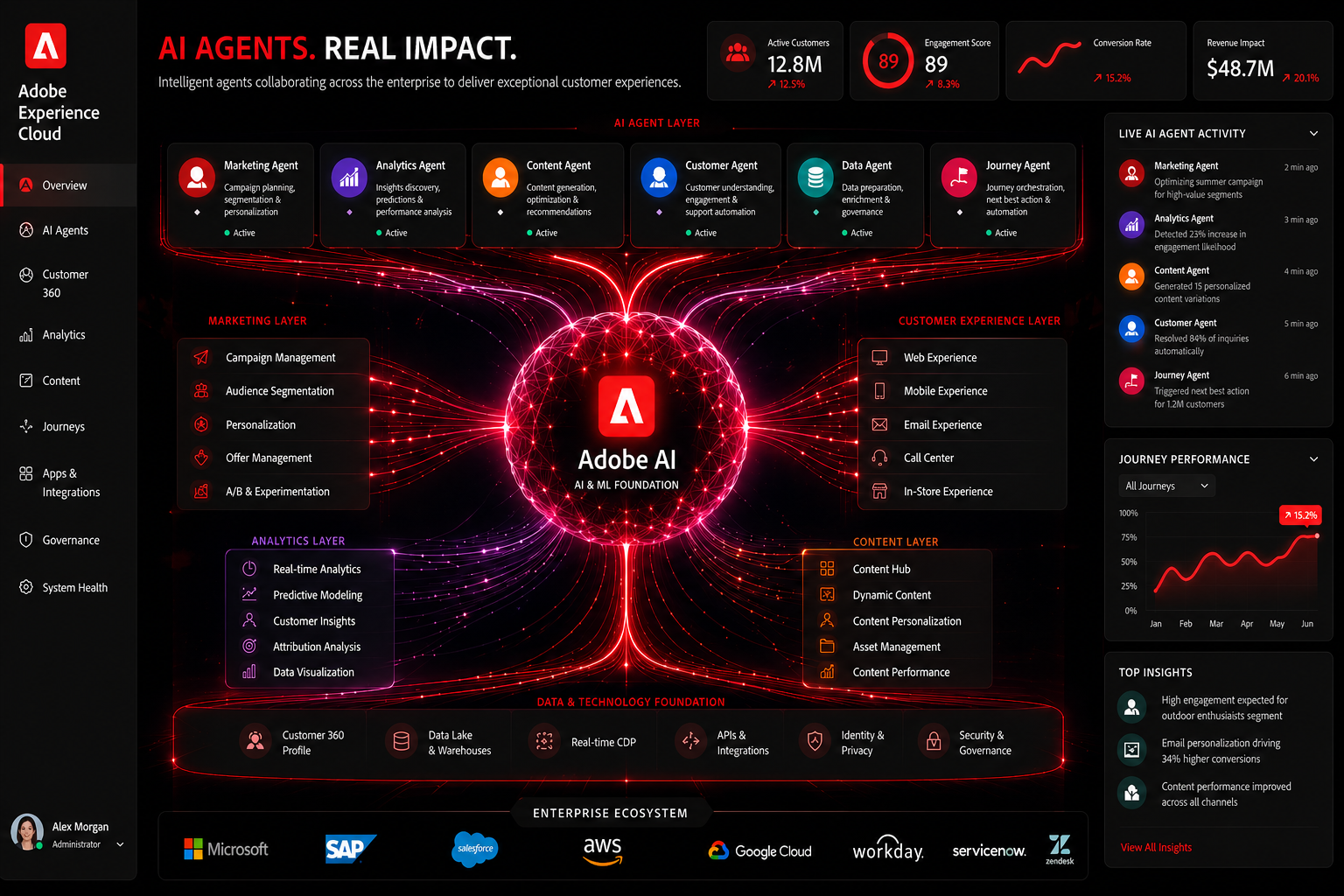
For the last few days, my LinkedIn feed has been flooded with posts about Adobe Summit 2026!
For those who are not part of the Adobe Summit wave and are interested in getting a glimpse of what it is and making the best use of Agentic CX Shift for an enterprise. This is the right post for you!
Before we get started on diving deep into the intricacies of Adobe CX Enterprise ecosystem, we shall first try to get some insights around Adobe Summit 2026.
Adobe Summit 2026 was not just another annual gathering of marketers, technologists, and digital leaders across the globe; it was a fundamental shift in how enterprises think about software, intelligence, and customer experience.
For years, Adobe Summit has been known for product announcements, roadmap updates, and customer success stories. But this time it was completely different. The tone of the keynote, the depth of sessions, and the alignment across tracks all pointed to one unmistakable direction:
“We are moving from a SaaS-driven world to an Agentic AI-driven enterprise.”
The Big Shift: From Tools to Autonomous Systems

Across multiple sessions, like:
- Building an Agentic System of Value (S817)
- Making Agent-to-Agent Marketing Work (S816)
- Agent Orchestrator Unpacked (S602)
- The Path to Agentic AI ROI (S850)
… the message was consistent and bold:
Software will no longer just be used by humans. It will act on behalf of humans.
This is not just automation, but running your in-house or digital agency as good as on autopilot.
Across 12+ tracks, I chanced upon a few interesting on-demand sessions, and four major themes emerged that define the future of Martech:
- Agentic AI is the New Operating Model
- Autonomous Content Supply Chain
- Pre-defined Customer Journeys Extinction
- AI interfaces are helping with brand visibility
Agentic AI is the New Operating Model
Until recently, AI marketing meant:
- Content creation using Gen AI tools
- Predictive scoring
- Basic automation
But now, Agentic AI is taking it into far more powerful: Decision-making + Orchestration + Execution.
We are entering the 3rd stage, where AI:
- Decides what to do
- Executes workflows
- Optimizes continuously
Of course, human in the loop across all these phases. MarTech fellows with experience and expertise now become an orchestrator from a mere operator.
Autonomous Content Supply Chain
If we had observed a few months or years back, the following were the major challenges in terms of the content supply chain:
- Long production cycles
- High costs
- Limited scalability
- Brand inconsistency
Gen Studio (Content & Performance Marketing) + Firefly is a great combination to overcome all these challenges.
We are now moving from:
- Ideation to AI-generated
- Creation to AI-tested
- Approval to AI-optimized, and
- Distribution to AI-activated
With this, we would be able to achieve infinite content variants, real-time optimization, and brand-aligned generative models.
Pre-defined Customer Journeys Extinction
Traditional marketing relied heavily on static journeys that involved pre-defined flows, rule-based triggers, and segment-based targeting and activation. But with today’s rapid customer behavioural changes, which are non-linear, context-driven, and real-time, the best approach would be Adaptive AI-driven journeys.
Adobe enables this with Real-time CDP, Journey Optimizer, and Agentic Orchestrator with analytics and optimization loop with Customer Journey Analytics and Mix Modeler.
This enables your brands with:
- Real-time decisioning
- Dynamic journey adjustments
- Hyper-personalized experiences
AI interfaces are helping with brand visibility
Customers are considering and slowly started relying upon LLMs, AI assistants, and conversational interfaces, not just search engines alone. This leads to GEO (Generative Engine Optimization), Adobe’s LLM Optimizer, Brand Concierge, and Brand Intelligence, which help the brands with just that. This would ensure your brand is discoverable by AI, your messaging is accurately represented, and your content is machine-readable too.
Recent acquisition of SEM Rush helped with this immensely, more read: https://news.adobe.com/news/2025/11/adobe-to-acquire-semrush
That said, here’s a summary of each session across the topics and products, helping you know the key capabilities.
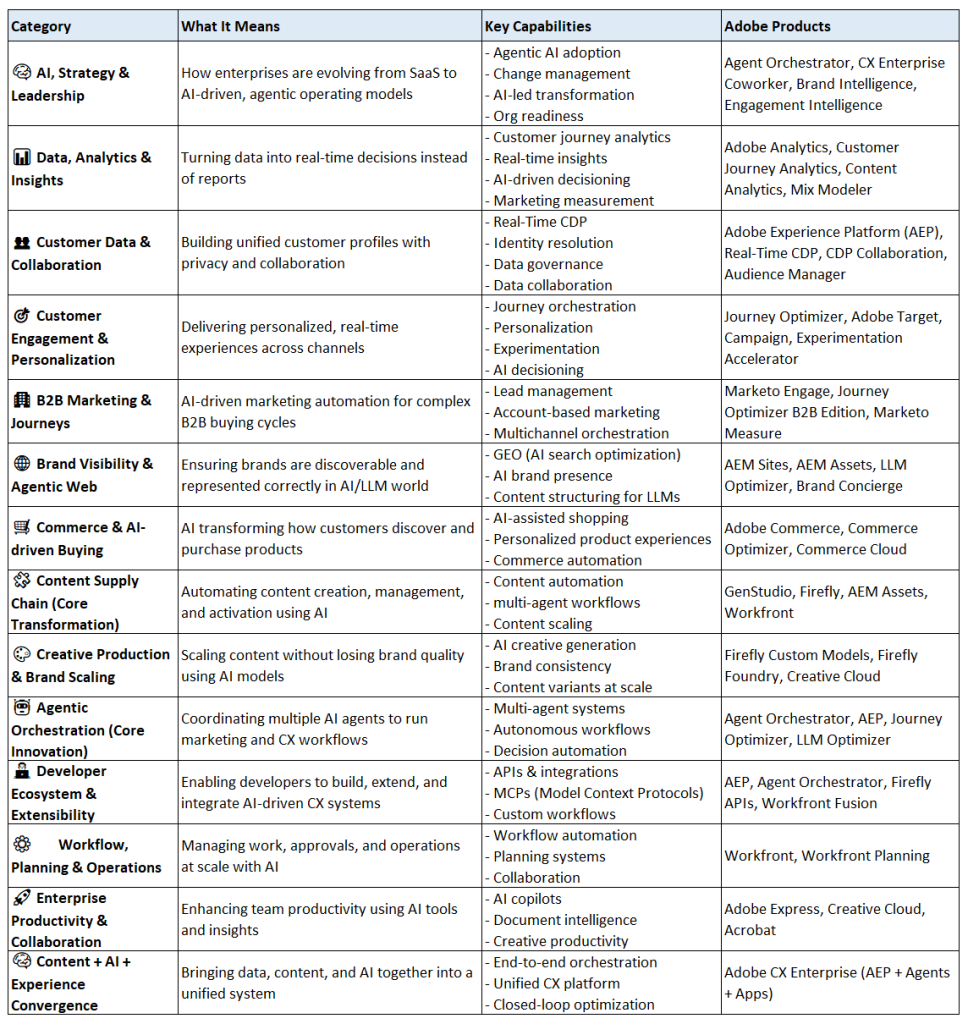
If you have time, you can go through all the sessions here: https://summit.adobe.com/na/sessions/#ai-innovation-and-leadership-trends
Final Takeaway from Adobe Summit 2026:
“Enterprises must evolve from managing tools to orchestrating intelligent systems.”
And this is where Adobe CX Enterprise comes into play.
Interested in knowing more about Adobe CX Enterprise?
Let’s get started. Take a break and resume scrolling through this post.
Understanding Adobe CX Enterprise Architecture
Adobe re-architected the entire experience cloud platform applications for Adobe CX Enterprise. It introduced a layered system where Data, Intelligence, Agents, and Experiences work together seamlessly.
Here is the high-level Adobe CX Enterprise Architecture for your reference.

#1: Business Outcomes – Experience Domains
If you have to optimize the marketing funnel, all you need is the branding for visibility, content for the reach, and engagement for conversions, eventually to turn the prospects into paying customers. Adobe has centered around these enterprise marketing goals that feed into your TOFU, MOFU, and BOFU.
- Brand Visibility
Here, the focus is on discoverability, SEO/GEO, and brand consistency. This is powered by Adobe Experience Manager and Agentic Web. - Customer Engagement
The focus here is on personalisation and real-time engagement with AEP native apps. - Content Supply Chain
Adobe Gen Studio offers content production at scale for both content marketing and performance marketing.
These AI-driven capabilities would speed up your marketing operations at scale to achieve various marketing and business goals across industries.
#2: Feedback Engine – Adobe CX Analytics Layer
This is an intelligence loop to drive insights using Adobe Analytics, Customer Journey Analytics, Content Analytics, and Marketing Campaign Analytics. Feedback engine layer would help brands with analysing user behaviour, generating insights, and feed AI agents to form a closed-loop optimization system.
#3: Heart of CX Enterprise – AI Platforms Layer
This is the transformation layer, which includes: CX Enterprise Co-worker, Agent Orchestrator, Adobe Agents + 3P Agents, Agent Skills, Tools, and MCPs. This is a new operating system for Digital Transformation and Customer Experience.
This is where agents can coordinate with each other to accomplish the desired business goals, over humans operating the tools that used to take more time and resource collaboration.
How does it work, you may ask?
- Content agents create assets
- Journey agents orchestrate flows
- Intelligence agent optimizes decisions
#4: Intelligence Layer – Brand and Engagement
Adobe introduced two new intelligence systems acts as a cognitive engine for the enterprises. They perform:
- Pattern analysis
- Predict outcomes
- Guide agent decisions
#5: Adobe Experience Platform (AEP) – Foundation Layer
AEP acts as a context layer for the entire ecosystem. Adobe has rearchitected the agentic system. This would feed the agents with the required:
- Unified customer profiles
- Real-time data ingestion
- XDM data modeling
- Identity resolution
- Data activation and more!
Imagine navigating a dense, uncharted forest without a map. AEP becomes the guide that helps you find your way.
The new architecture Paradigm:
- AEP > Context
- Analytics > Intelligence
- Agents > Execution
- AJO > Orchestration
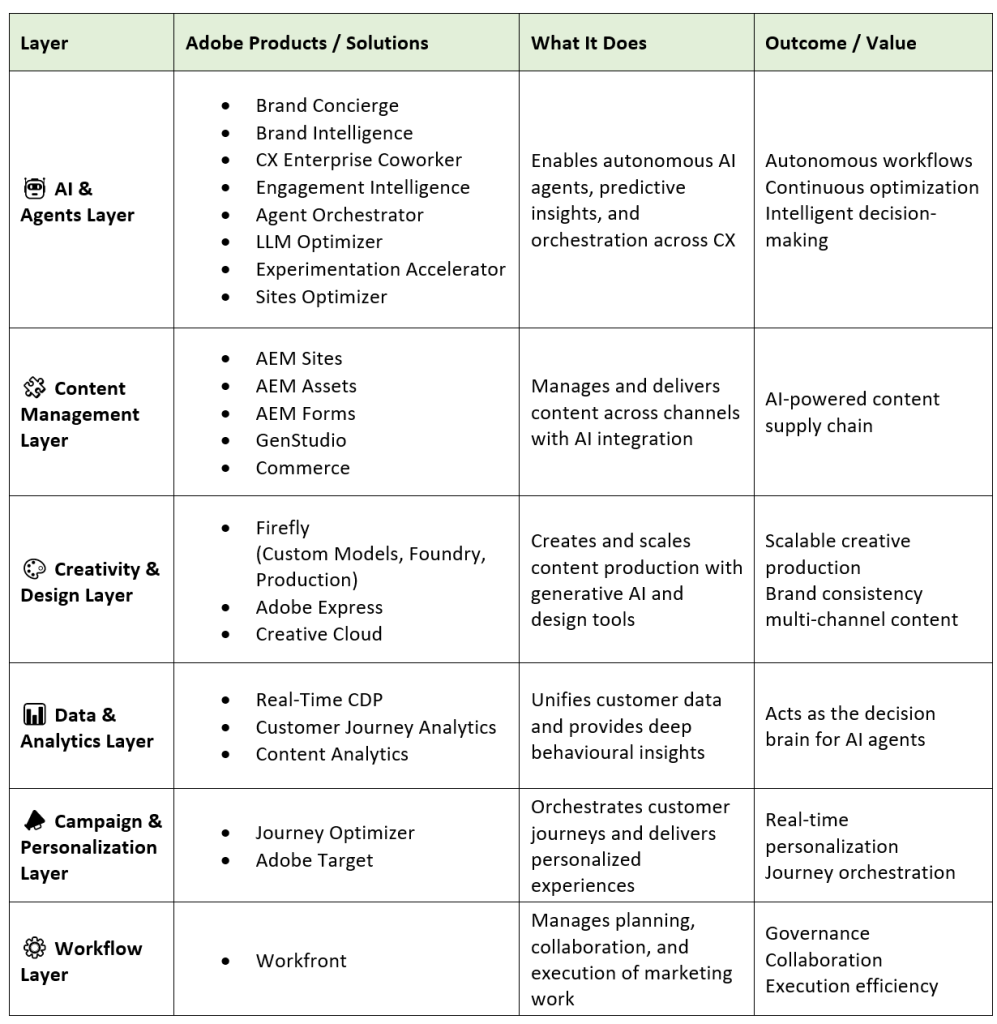
All these sound good and exciting, but can we use this knowledge to get into the practice mode now?
Let me walk you through a Point of View on how to make this work for a retail enterprise.
Retail Use case
Agentic Customer Experience Transformation (Deep Dive)
The retail industry is at a critical inflection point. Customers today:
- Expect hyper-personalized experiences
- Interact with multiple channels simultaneously
- Make decisions faster than ever (often within seconds)
- Increasingly influenced by AI-driven recommendations (NBA: ML) and interfaces (AI: Chatbots)
While this is true for customers, retailers are struggling with fragmented customer data, leading to missed opportunities; slow campaign execution cycles mean slow time-to-market; high content production costs badly affect the operational costs; and inconsistent personalization across the channels results in a poor customer experience.
McKinsey estimates that personalization at scale can deliver 5–15% revenue uplift and 10–30% marketing spend efficiency.
Considering this situation, we shall now get into the business objectives for this retail enterprise:
- Increase the conversion rate by around 20%
- Reduce campaign execution time by 40-60%
- Improve Customer Lifetime Value (CLV)
- Reduce content production cost by 30-50%
- Enable real-time personalization across channels
Before we dive into the build mode, let us align on the product stack with the flow:
- Data Collection: AEP (Web, App, CRM, POS)
- Customer 360 View: Real-time CDP
- AI Agents: Decision + Orchestration
- Journey Execution: AJO + Target
- Content Supply Chain: Gen Studio + Firefly
- Measurement: CJA + Analytics
Gartner predicts that by 2027, over 20% of customer interactions will be handled by AI agents.
Architecture

Here is the high-level agentic experience & intelligence solution diagram that addresses the problems and achieve the desired business goals.
This architecture helps the enterprise move towards the Agentic AI operating model from the Traditional AI approach:
- Campaign-driven to Context-driven
- Human execution to Human-monitored & approved AI execution
- Static / Dynamic journeys to AI-driven, on-the-fly, dynamic personalized journeys
- Batch optimization to Real-time optimization
This is where Adobe CX Enterprise becomes a game-changer.
Customer Journey

Step 1 – Awareness Stage: Customer Entry
A customer lands on the website via: paid ad/organic search/AI-generated recommendation (LLM interface).
- Data Collection:
Adobe collects the behavioural data via Web/Mobile SDK (AEP) and captures the events such as: Page views, referrer source, campaign attribution, device, and geo data.
- Data Processing:
Anonymous to known user identity resolution via AEP + RTCDP through AEP ID services. Profile gets enriched with behavioural web event data, historical purchase data, and preferences. A unified profile gets created within milliseconds.
- Agent Activation:
Engagement Intelligence Agent predicts the user intent (browsing vs buying), Brand Intelligence Agent ensures brand messaging consistency, and LLM Optimizer ensures content aligns with AI-driven discovery.
Step 2 – Consideration Stage: Dynamic Personalization
Here, the AI calculates Propensity score, Product affinity, and Price sensitivity based on the known user’s profile and behavioural data stored in the AEP data lake.
Now with AEP Agent Orchestrator, multiple agents collaborate:
- Content Agent: Generates product banners using Firefly and Adapts visuals based on user persona.
- Journey Agent: Determines next best action. Decides whether to: Show offer, or Recommend products, or Trigger email/SMS/Push.
- Adobe Target (Personalization): Modifies: Homepage layout, Product recommendations, and offers.
We need content to perform any of the above-mentioned MarTech Agentic Orchestration; here is where the content supply chain would be in action mode. Using Gen Studio + Firefly: A Retail brand can generate multiple product creatives and personalized messaging in alignment with the channel-specific formats.
Example:
You may want to test a product with 10 variations across different angles, like: Discount-focused, Premium-focused, or Sustainability-focused. You can try various other angles to the variations to produce infinite creative assets.
BCG highlights that companies using AI in marketing see up to 2x improvement in conversion rates
Step 3 – Conversion Stage: Journey + Decisioning + Optimization
Using AJO now is the time to run real-time journeys with possible triggers: Push notifications, email reminders, and on-site offers based on the Cart Behaviour, Intent score, and Timing.
Instead of rules, AI selects: Best Channel, Best Timing, and Best Offer.
Once campaigns are up and running, after the required data points collection to draw insights on to optimize the campaigns, AI runs: A/B tests automatically, Multivariate testing, and Continuous optimization.
Step 4 – Retention and Loyalty: Post-purchase & CLV
Agents trigger: personalized follow-ups, Loyalty programs, and Cross-sell recommendations as post-purchase engagement campaigns. Using Customer Journey Analytics: AI identifies High-value customers, Churn risk, and Upsell opportunities.
PLEASE NOTE: This strategy is a combination of Adobe CX Enterprise, AEP Agent Orchestrator, and manually running a few agents on demand. Before we jump into agentic orchestration, we need to ensure a strong data foundation, data governance, and privacy in place with established integrations across upstream and downstream systems.
PLEASE NOTE
This strategy is a combination of Adobe CX Enterprise, AEP Agent Orchestrator, and manually running a few agents on demand. Before we jump into agentic orchestration, we need to ensure a strong data foundation, data governance, and privacy in place with established integrations across upstream and downstream systems.
Now we have understood the entire marketing flow for a user from anonymous to known to customer to increase the CLV.
Data
Let us look into the data model and data architecture for the use-case at a high-level.

Here is the data we are getting from the various source systems: Behavioural data from Web/App, Transactional Data (Payment Gateway), Engagement Data (Delivery Logs), Campaign Data, Content Interactions, etc.
XDM Data Model
Now it’s time to convert the existing Entity Relationship Diagram to an XDM specific data model based on the understanding of different source systems, data points, and data types, and transformation requirements along the way.

Integrations
Below are the potential Integrations we may use for this retail use-case:
- Upstream: Web/App, Existing Data Warehouse/Data Lake, Payment/Transaction, CRM (Salesforce/SAP), POS Systems, E-com platforms.
- Downstream: Ad Platforms (Re-targeting Ads), Email/SMS/Push Notifications, Customer Service tools.
We can use the existing available OOTB connectors, Streaming endpoints (APIs), and Edge Network for Web or Mobile SDKs.
Agentic Orchestrations
How do agents collaborate, you may ask?
- Engagement Intelligence > Predict Intent
- Brand Intelligence > Maintain Consistency
- Content Agent > Generate Creatives
- Journey Agent > Orchestrate Flows
- Personalization Agent > Deliver Experiences
Here is the high-level agentic workflow breakdown for your reference:
- Event triggered
- Profile updated (AEP)
- AI models compute signals
- Agent Orchestrator coordinates actions
- Journey executed (AJO)
- Experiences delivered (Target)
Analytics Loop (Continuous Optimization)
While running campaigns on autopilot is good, monitoring the journey or overall campaign performance keeps the marketing budget intact while achieving the business goals. Closed feedback loop:
- Experience delivered
- Customer interacts
- Data captured
- Analytics updated
- AI models retained
- Agents improve decisions
- CJA: Lifecycle insights
- Content Analytics: Content performance
- Marketing Analytics: Campaign ROI
Some of the optimization tactics that can be adopted are: Identify low-performing creatives, optimize channel mix, improve conversion paths, and reduce churn.
Business Impact
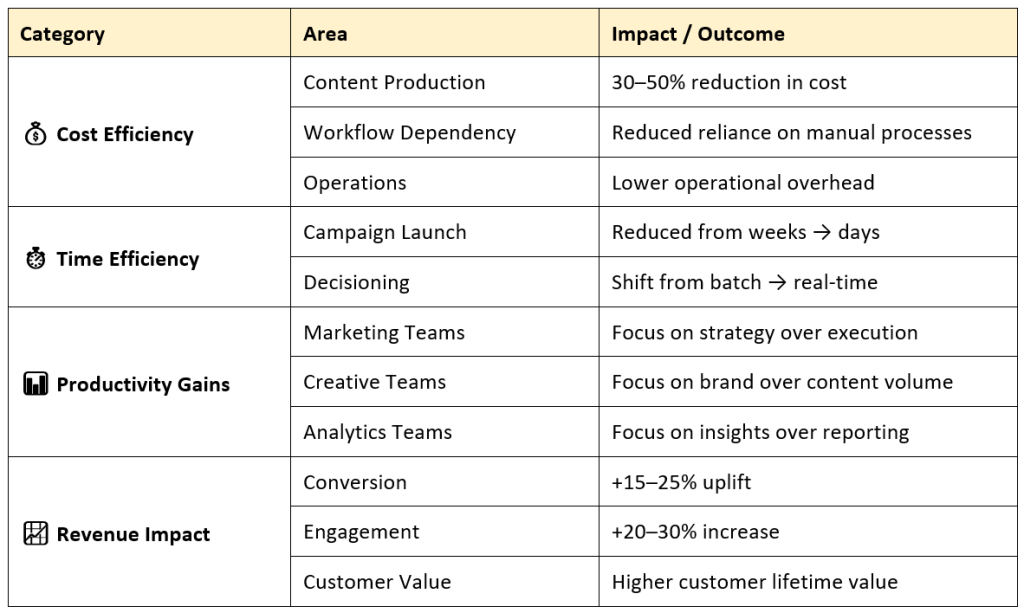
These are the key metrics that we can track and measure post go-live across the journeys and markets.
Security & Governance
Adobe allows various security and governance methods to safeguard your enterprise customer data and enables responsible AI usage with:
- RBAC: Role-based access control
- GDPR, HIPAA, and CCPA: Data privacy compliance
- AEP: Basic Consent Management
- AI governance: Firely (brand safe models) and LLM Controls
- Workfront: Audit trails and workflow approval
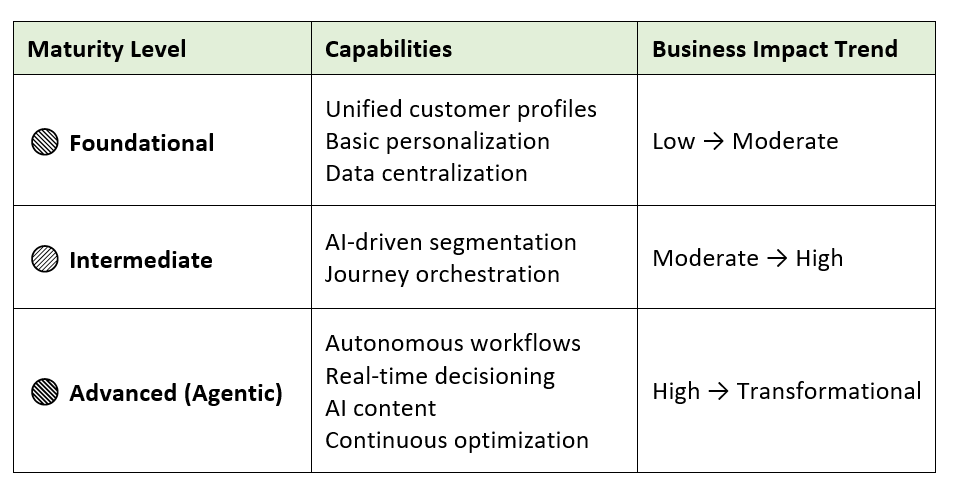
MarTech Maturity Model for a Global Retail Enterprise:
Final Thought:
Retail is no longer selling products and running campaigns. It is about delivering Intelligent and Adaptive experiences. The real transformation is from reactive to responsible + predictive + autonomous engagement.
During development, you can use a conversational interface using Adobe CX Enterprise to define your marketing goal so that the platform will get started on the execution post approval, or you can start orchestrating the applications and services for your custom business needs.
Agentic AI doesn’t just improve marketing. It redefines how retail businesses operate, compete, and grow.
Adobe CX Enterprise provides the platform, intelligence, and orchestration layer to make that future real today.
