


“I’ve learned that people will forget what you said, people will forget what you did, but people will never forget how you made them feel.”
~ Maya Angelou, 1928 – 2014
This is the crux of customer experience and human relationships in general!
We might feel good to think that we have evolved so much so that the technologies would be able to automate our day-to-day operations and activities in our life to a certain degree. We might be in the frontal lobe civilization, however most of the core of our decisioning is still led by survival instincts and reptilian brain.
Sensing neuroscience, probably in my future posts!? I would love to cover them more. 😊
At the end of the day, it’s the human-to-human connection behind the scenes of customers engaging in your great products or services that matter the most while we serve them whatever we have to offer them with.
“We could be a technical genius but if we fail to understand other human being and their feelings and emotions that drives their actions, our technical or business knowledge is of little to no use.”
A few examples on innovations that served no real purpose are: Google Glass, Apple Newton, Microsoft Windows Phone, Segway PT, 3D TV, IBM PCJr etc.
How do we realize what customer wants?
That’s where the MarTech stack comes in powered with Agentic and Gen AI capabilities enhancing the scale of reaching our target audience one-to-one with personalized offers while understanding their needs through their engagements with the brands.
Imagine your existing customers are delighted as and when they engage with your brand and help you with a win-win situation through repeated orders?
Oh! Sounds, too good to be true! Right?
But we MarTechies say it’s possible and has been happening with many brands like you with our excellent @Adobe’s Experience Cloud Solutions with @IBM being their premium delivery partner powered with Agentic & Gen AI capabilities supporting team’s productivity and helping client’s grow their businesses across the industries.
You might be guessing now what it takes to build a solution where your customers feel safe, engaged, and delighted with your products and services. Not just sit and guess out but with data-backed decisions.
All at once? Is it even possible? You would be wondering!
Let’s ty to dig deep into what it is:
- Safe: Adobe’s strong data labeling and governance policies (DULE) offer enterprise data privacy and policies for user consent enabled marketing actions
- Engage: Omnichannel customer journey orchestration with Email, SMS, and Push for unified profiles
- Delight: Delivering the personalized content customers want to consume across devices & channels at the right time to better navigate their next best actions
- Data-driven: None of the above matters if it is not data-backed facts with user’s historical and campaign feedback data loop for continuous optimization and innovation
Yes! It’s all about delivering exceptional ‘customer experiences not just selling the ‘stuff’ —and Adobe Experience Cloud empowers you to do just that, backed by IBM’s robust Adobe practice leadership and innovative technologies like IBM WatsonX!
Through strategic implementation of Adobe Experience Cloud solutions—including AEP, Journey Orchestration, Gen Studio, Firefly, Customer Journey Analytics, Adobe Target, and AEM—IBM is enabling enterprises to deliver personalized, data-driven customer experiences at scale with Gen AI and Agentic AI Capabilities.
Here is a short story of Emma, a 32-year-old fashion enthusiast.

“Emma scrolls Instagram and sees a personalized ad promoting a sustainable fashion brand. Emma clicks on the ad and lands on a sleek, fast-loading website that highlights eco-friendly collections tailored for her. She then adds the products to the cart, and during checkout she has also been offered a curated bundle and limited-time offer. After her purchase, she receives an email with a thank-you note, a tracking link, and personalized outfit tips. “
Marketing Funnel & Adobe MarTech Products Mapping:
Let’s look at the various moving components of Adobe Experience Cloud and how its natively integrated solutions work together to deliver this seamless full-funnel customer experience.
| Product | Funnel Stage | Activity |
| AEP | Awareness | Unified customer profile from past touchpoints |
| Journey Optimizer | Awareness | Triggers campaign delivery via Instagram, based on interest in sustainable products |
| AEM | Consideration | Dynamic content delivery with localization |
| Adobe Target | Consideration | A/B tested homepage and product recommendations based on AI models |
| Adobe Analytics | Consideration | Tracks Emma’s interactions (time on page, products viewed, scroll depth, add to cart button click, purchase button click etc.) |
| Journey Optimizer | Engagement | Multi-channel, triggered post-purchase email |
| AEP | Engagement | Adds purchase data to her customer profile for future personalization |
| FireFly | Engagement | Generates AI visuals for styling tips using Emma’s selected products |
| Adobe Target | Purchase | Personalized bundles and urgency messaging based on her browsing history |
| AJO + AEP | Purchase | Triggers an email and in-app push reminder if she abandons the cart |
| Commerce | Purchase | Enables dynamic pricing, loyalty points redemption |
| Gen Studio | Loyalty & Advocacy | Orchestrates a full-funnel campaign (copy, image, variants) with brand governance. |
| Workfront | Loyalty & Advocacy | Streamlines content creation and approvals across marketing teams |
| AEP + WatsonX | Loyalty & Advocacy | Predicts next-best offers based on Emma’s behavior and lifecycle |
Up till here we have covered from the business angle on the various application services that adobe offers, its time to dig deep into technicalities into how to make this into a workable solution.
TOGAF Technical Architecture:
As an enterprise architect following TOGAF architectural layers now I would evaluate technological alignment across business outcomes.
Here is a comprehensive view of different architecture solution building blocks such as Business, Data, Technology, and Application come together to deliver a unified customer experience as per TOGAF standard.
| TOGAF Layer | Architecture Building Block (ABB) | Solution Building Block (SBB) |
| Business | Customer Segmentation | Real-Time Customer Profile Services |
| Business | Journey Orchestration | AJO + Offer Decisioning |
| Data | Unified Customer Profile | AEP Identity Service |
| Data | Behavioral Analytics | Adobe Analytics + Web SDK |
| Application | Content Management | AEM Sites + FireFly + GenStudio |
| Application | Experimentation & Personalization | Adobe Target |
| Technology | Edge Data Collection | Adobe Web SDK (Alloy.js) & Mobile SDK |
| Technology | Machine Learning/Prediction | WatsonX + Adobe Sensei |
| Technology | Data Privacy and Governance | DULE Labels & Policies |
| Technology | Integration & API Gateway | Adobe I/O Runtime |
In the Business Architecture layer, customer segmentation is operationalized through Real-Time CDP in Adobe Experience Platform (AEP), enabling high-fidelity audience resolution and persona-based activation. Journey orchestration, encompassing real-time decisioning and contextual offer management, is powered by Adobe Journey Optimizer (AJO) in tandem with Offer Decisioning capabilities enabling dynamic, omnichannel experience delivery.
Within the Data Architecture, unified customer profiling is achieved via the Adobe Identity Service integrated into AEP, enabling deterministic and probabilistic identity stitching at scale. Behavioral analytics data are captured using Adobe Analytics in conjunction with the Adobe Web SDK (Alloy.js), enabling telemetry ingestion and actionable behavioral insight generation in real-time.
The Application Architecture is anchored by modular content operations, where Adobe Experience Manager (AEM) Sites and GenStudio provide scalable content authoring, templating, and asset orchestration pipelines. Concurrently, Adobe Target facilitates server-side and client-side experimentation, allowing A/B and multi-variate testing and AI-driven personalization for experience optimization.
At the Technology Architecture tier, the Edge Data Collection framework, enabled via Adobe Web SDK (Alloy.js), ensures low-latency telemetry ingestion and activation at the edge. Predictive intelligence and AI/ML-driven enrichment are embedded through hybridized use of WatsonX and Adobe Sensei, enabling custom model deployment and inferencing across experience workflows.
Adobe Workfront underpins governance, task orchestration, and content supply chain velocity, while Adobe I/O Runtime provides a serverless API gateway and extensibility framework for composable integrations across internal and third-party systems.
This reference model demonstrates how layered architectural thinking can abstract solution building blocks (SBBs) into composable, scalable Martech ecosystems that align tightly with business imperatives.
Now it’s time to sleeve up to get into the solution design activities.
High-level System Integration Diagram
From AEM to AEP with Workfront as governing entity, let’s look at how different systems integrate together to come and deliver this beautiful customer journey for Emma’s experience with the fashion brand.
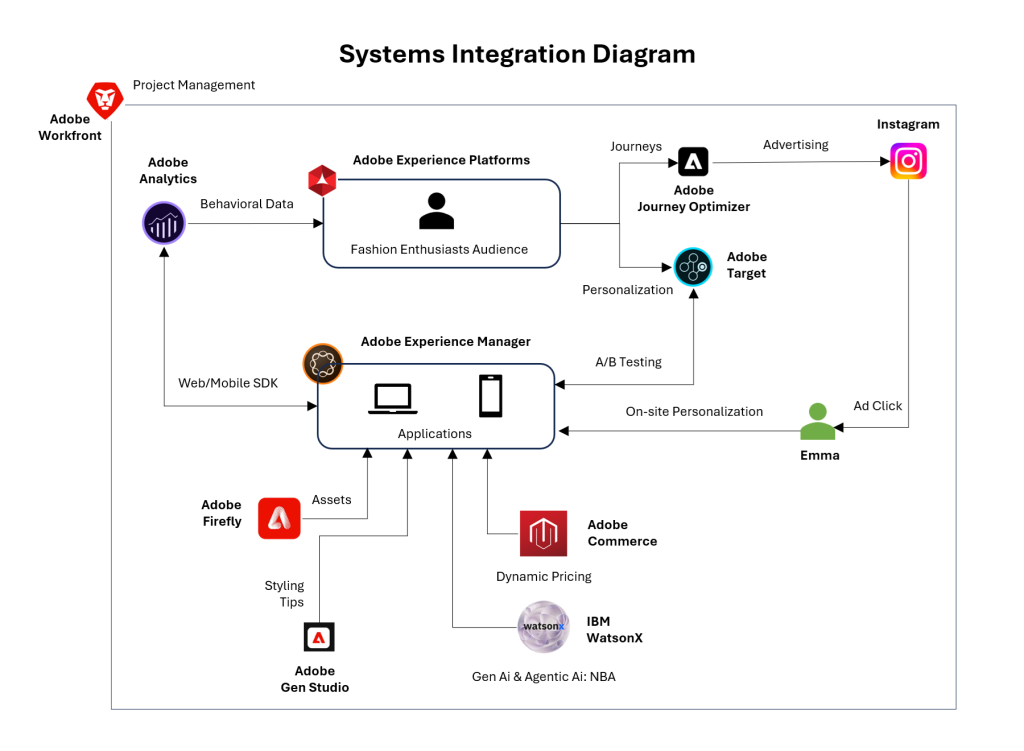
It is time for us to integrate these moving parts to make them communicate with each other.
Below are the technicalities involved in multiple systems integration:
- AJO & Instagram: Emma is shown a personalized Instagram ad powered by AJO audiences built from her real-time AEP profile and recent purchases.
- Adobe Analytics & AEP: As Emma explores the site, her browsing data from Analytics instantly enriches her profile in AEP to refine future recommendations.
- AEP & AJO: Emma’s updated profile in AEP automatically triggers a personalized thank-you and outfit-tip email from AJO right after her purchase.
- AEP & Adobe Target: Emma sees real-time products and offer personalization on the website based on her fashion enthusiasts segment stored in AEP.
- AEM & Adobe Target: The AEM site dynamically tailors Emma’s homepage banners and featured collections through Target’s AI-powered recommendations.
- AEM & Adobe Analytics: Every click and scroll Emma makes on the site is tracked by Analytics through AEM to optimize her digital experience.
- AEM & Adobe Firefly: Emma’s follow-up emails and site visuals feature AI-generated eco-styled outfits created in Firefly within AEM Assets.
- AEM & Adobe Gen Studio: The marketing team uses Gen Studio integrated with AEM to quickly craft and publish personalized visuals and stories for Emma’s segment.
- AEM & Adobe Commerce: When Emma adds items to her cart, AEM pulls real-time product data and discount prices from Adobe Commerce for a seamless shopping flow.
Let us dig deep into the technical intricacies of how this gets done with multiple products and systems integrated to achieve a common goal to help Emma have the best customer experience with fashion brand.
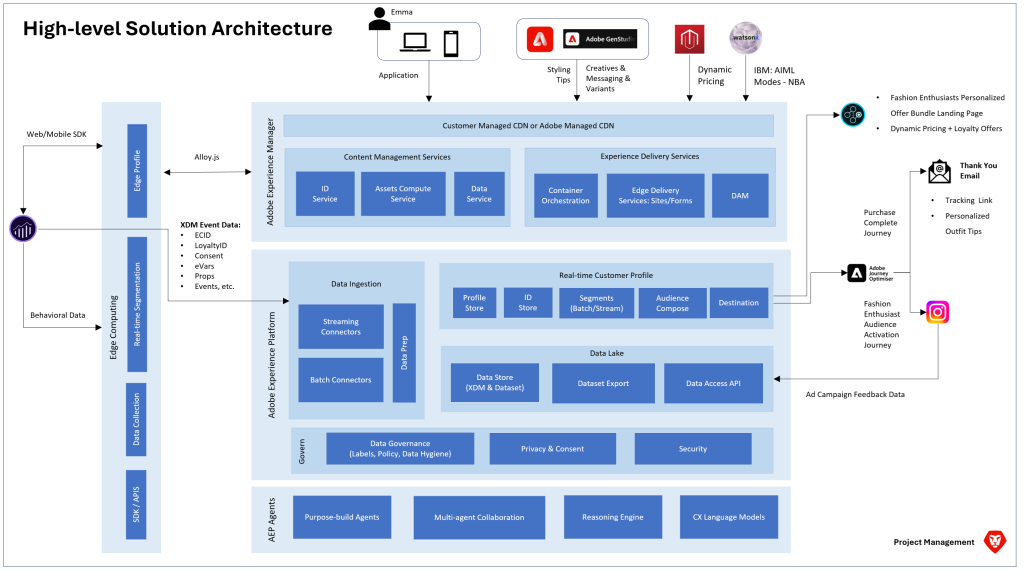
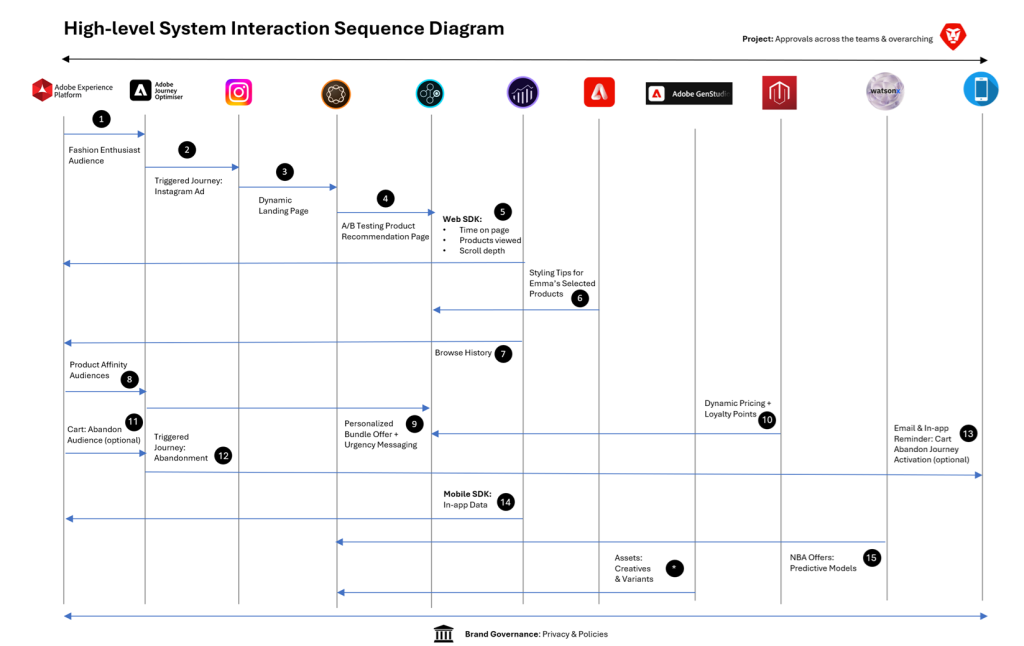
System Interaction Sequence Diagram
This Adobe Experience Cloud-powered stack is a modern, composable, and modular digital experience platform, compliant with TOGAF ADM principles. It uses a mix of cloud-native applications, AI/ML predictive modeling, API-driven orchestration, and governed content delivery.
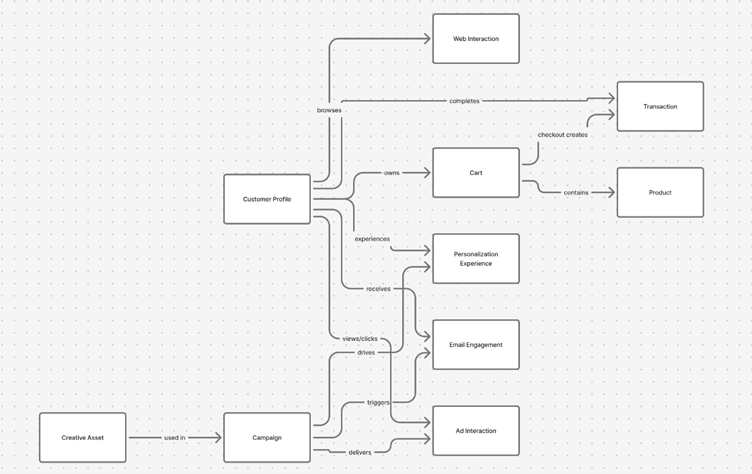
Let’s look at the data side of things to understand how data attributes communicate between the entities to serve the purpose.
Entities:
- Customer Profile (AEP)
- Campaign (AJO / Target / Instagram)
- Ad Interaction (Instagram)
- Web Interaction (AEM + Analytics)
- Product (Adobe Commerce)
- Cart (Commerce)
- Transaction / Purchase (Commerce + AEP)
- Personalization Experience (Target)
- Email Engagement (AJO)
- Creative Asset (AEM Assets / Firefly / Gen Studio)
Entity Definition and Key Attributes:
| Entity | Source System | Key Attributes | Purpose |
| Customer Profile | AEP (RTCP) | Profile_ID (Primary Key), ECID, Name, Email, Preferences, Segments, Channel_Consent | Unified profile that links all channel data |
| Campaign | AJO / Target / Instagram | Campaign_ID (PK), Channel, Offer_Type, Target_Segment, Start_Date, End_Date | Defines marketing activity targeting a specific audience |
| Ad Interaction | Instagram / Meta API → AEP | Ad_Interaction_ID (PK), Profile_ID (FK), Campaign_ID (FK), Platform, Click_Timestamp, Ad_Type | Tracks Emma’s ad views/clicks |
| Web Interaction | AEM + Analytics → AEP (via Web SDK) | Web_Event_ID (PK), Profile_ID (FK), Page_URL, Event_Type, Timestamp, Device_Type, Referrer | Captures real-time web activity |
| Product | Adobe Commerce | Product_ID (PK), Category, Price, SKU, Sustainability_Tag | Master product catalog |
| Cart | Adobe Commerce → AEP | Cart_ID (PK), Profile_ID (FK), Product_ID (FK), Quantity, Added_Timestamp, Session_ID | Tracks items Emma adds to cart |
| Transaction | Commerce → AEP | Transaction_ID (PK), Profile_ID (FK), Cart_ID (FK), Order_Value, Payment_Mode, Transaction_Timestamp | Captures completed purchase data |
| Personalization Experience | Adobe Target ↔ AEP | Experience_ID (PK), Profile_ID (FK), Target_Activity_ID, Variant_Shown, Conversion | Logs personalized content served |
| Email Engagement | AJO → AEP | Email_Event_ID (PK), Profile_ID (FK), Campaign_ID (FK), Email_Type, Open_Timestamp, Click_Timestamp | Tracks post-purchase email engagement |
| Creative Asset | AEM Assets / Firefly / Gen Studio | Asset_ID (PK), Asset_Type, Source (Firefly / Gen Studio), Tag, Version | Stores AI-generated or curated content used in campaigns |
Cardinality & Relationship Details
Here is the cardinality and relationship details between the entities.
- Customer Profile 1—∞ Ad Interaction
Emma can view/click many Instagram ads. - Customer Profile 1—∞ Web Interaction
Each profile has multiple browsing sessions. - Customer Profile 1—∞ Cart
Emma can create multiple carts (sessions). - Cart ∞—∞ Product
Many products can belong to one cart; a product can appear in many carts (link table). - Customer Profile 1—∞ Transaction
One customer can make multiple purchases. - Customer Profile 1—∞ Email Engagement
AJO sends many emails to a single profile. - Campaign 1—∞ Ad Interaction / Email Engagement
A single campaign can generate many ad/email engagements. - Customer Profile 1—∞ Personalization Experience
Emma can experience multiple personalized offers. - Creative Asset 1—∞ Campaign / Experience
One asset (from Firefly or Gen Studio) may be used in multiple campaigns.
High-level Data Model
Here’s an interactive ERD diagram for Emma’s Journey, it visually maps how all entities (Customer Profile, AEM, AJO, Target, Commerce, etc.) interrelate through her personalized experience.
Business Impact
The very fabric of the brand’s existence, enabling the best customer experience through MarTech platforms with value driven business approach.
With AEC & IBM WatsonX, you can significantly enhance marketing efficiency, maximize customer yield, and drive better Return on Marketing Investment (ROMI).
Let’s look at how MarTech stack is impacting the business with key metrics across various stages of the Emma’s experience journey.
| Funnel Stage | Business Impact |
| Awareness | Hyper-targeted ad impressions with higher engagement |
| Awareness | Efficient spend via real-time data activation |
| Consideration | Improved conversion paths using behavioural targeting |
| Consideration | Continuous content optimization through real-time testing |
| Engagement | Higher post-purchase satisfaction and brand affinity |
| Engagement | Less manual creative work with GenAI-powered visuals |
| Purchase | Reduced cart abandonment |
| Purchase | Increased average order value through AI-generated bundles |
| Loyalty & Engagement | Faster campaign execution at scale |
| Loyalty & Engagement | Increased customer retention and lifetime value |
Achieving Operational Efficiency:
A focused approach to balance personalization depth with operational efficiency across Adobe Experience Cloud implementations. Some of the best practices to adopt are:
- Addressable Audience Size
- Limit activation to known visitors with high engagement probability
- Profile Richness:
- Only ingest core identifiers (ECID, email hash)
- Controlled Growth: Introducing new loyalty attributes (e.g., referral_count) via versioned schema
- Event Retention & Expiration
- Store clickstream events for 90 days; drop unqualified leads
- Streaming vs Batch
- Stream only “Add to Wishlist” events
- Batch-upload product browsing data nightly
- API Call Volume
- Consolidate journey actions in AJO via batched payloads
- Avoid per-customer webhook calls
- Cost Sensitivity Layer
- Mark checkout personalization as “high-cost/high-impact”
- Data Lineage & Minimization
- Retain order ID, timestamp, product category only; archive detailed cart data
- Alignment with Use Cases
- Focus only on “repeat purchase” and “feedback” journeys
- Continuous Optimization Loop
- Monthly audit: active profiles, campaign API cost, conversion impact.
Operational Focus – Platform Implementation Optimization Approach
Implementation success often slips when platform capabilities are underutilized. These best practices help ensure hyper-focused execution across funnel stages through operational and architectural alignment.
- Content exposure & segmentation
- Journey Stage: Awareness & Discovery
- Adobe Components: AEM, Analytics, Target
- Implementation: Emma visits homepage, no unnecessary ingestion of anonymous traffic
- Behavioral event tracking & personalization
- Journey Stage: Engagement & Consideration
- Adobe Components: Web SDK, AEP Edge, AJO
- Implementation: Emma browsers handbags (high-intent signals; add-to-Wishlist), use remarketing for the funnel dropouts
- Transaction, decision, and offer delivery
- Journey Stage: Purchase & Conversion
- Adobe Components: AEP Profiles, Commerce, Target
- Implementation: Emma checks out, offer personalization through a single batched API
- Follow-up journeys & loyalty segmentation
- Journey Stage: Post-purchase & Retention
- Adobe Components: AJO, CJA, Analytics
- Implementation: Emma receives a thank-you email & loyalty points, page-dwell archived after 3 months
- Loyalty, referral, and cross-sell
- Journey Stage: Advocacy & Upsell
- Adobe Components: AJO, AEM, Target, CJA
- Implementation: Quarterly analysis shows Emma’s cohorts has low open rates, next campaign cost adjusted
You can have something like this below to track your business performance with AEC adoption to your marketing strategy.
| Metric | Frequency | Target Threshold | Tool / Source |
| Active Profiles | Monthly | < License Tier (e.g., 80%) | AEP Monitoring Dashboard |
| API Call Volume | Weekly | < 70% of rate limit | Journey Action Logs |
| Streaming Events Count | Monthly | < 30% of all events | Data Ingestion Logs |
| Data Storage | Quarterly | Growth < 10% QoQ | AEP Data Lake Reports |
| ROI per Use Case | Quarterly | ≥ 2.0 | Business ROI Dashboard |
Design Guidelines for Emma’s Architecture Diagram
🔴 High Cost, High Impact: Streaming ingestion, real-time personalization, identity stitching
🟡 Moderate Cost, Scalable: Batch ingestion, AJO orchestration
🟢 Low Cost, Stable: AEM content delivery, CJA dashboards
Add these as tags in your architecture:
Example: AJO Journey Orchestration [🟡 Moderate Cost | High Scalability]
IBM + Adobe: Collaboration & Client’s Business Growth
Want to see who is doing what with adobe products and how IBM is driving it through?
Here is a comprehensive view of our few example clients across the industries realizing their ROMI with adobe and IBM products delivering personalized customer experiences at scale.
Adobe: https://business.adobe.com/customer-success-stories.html