Recently, when I was having a casual conversation with my old friend from a Commerce Practice, we chatted about the ongoing challenges they are facing, as well as some good and not-so-good moments.
But when we discussed inventory overstock and stockouts, they always exhibited some sort of dispassion. Despite having access to the massive enterprise datasets—transactions, customer feedback, POS systems, campaigns, and analytics data.
The team continues to struggle with inaccurate forecasting and disjointed marketing execution. What do they lead to?
- High holding costs
- Lost sales
- Wasted marketing budgets, and
- Poor customer experiences
Traditional forecasting methods are either too simplistic to capture consumer dynamics or too siloed to inform marketing in real-time.
Marketing teams, in parallel, face disconnected workflows, manual analysis, and one-size-fits-all campaigns that fail to resonate with customers in the right moment.
Here are some real-time facts on these problems that businesses are facing currently.
Inventory Management & Stock Challenges | Inventory mistakes with manual errors | 60% | |
Retailers cite inventory management as their biggest challenge | 43 – 65% | ||
Poor inventory control leads to higher operational costs | 10 – 30% | ||
Online shoppers abandon their cart if an item is out of stock | 69% | ||
Inventory inaccuracies cost U.S. retailers approximately | $55 B |

While I was taking a look at the current consumer dynamics, some of the strong signals that I could think of are:
- Fickle consumers: Preferences shifting based on seasonality, region, and often due to unpredictability.
- Non-negotiable Competitiveness in the Industry: A single missed opportunity, be it an out-of-stock product or a mistimed promotion, would lead consumers to competitors easily.
- Marketing budget wastage: Without the right contextual insights would often end up serving irrelevant offers to the customers, which lowers engagement and brand trust.
When I ponder over what’s causing this serious issue over and over again?
The answer is…
The disconnection between inventory planning and omnichannel marketing.
This causes two major roadblocks for any business to flourish:
- Operational inefficiency
- Strategic liability
Businesses fail to align their supply chain with customer demand, causing risk both in terms of:
- Profitability
- Customer loyalty
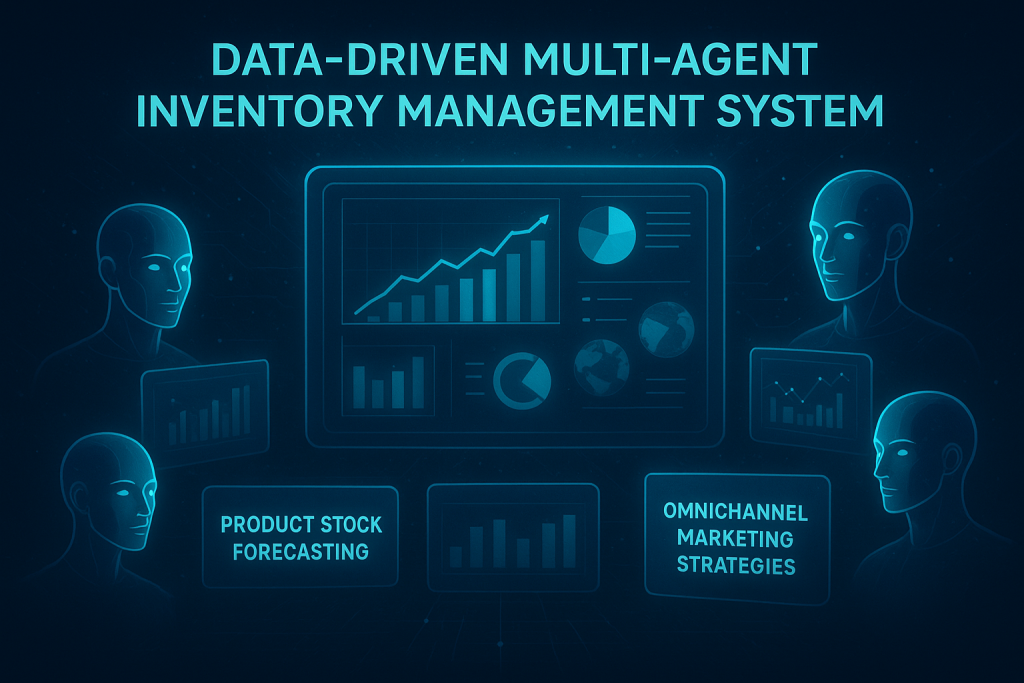
How do we tackle this serious business challenge? The solution is: a Data-driven Multi-agent Inventory Management system offering a platform to solve product forecasting and omnichannel marketing strategies to resolve the issues to bring about harmony between the two siloed enterprise business operations. Built on Agentic AI Architecture, it combines specialized assistants and agents to create a closed-loop intelligence system.
AI Assistants for Intelligence
- Product Affinity Assistant: Learns customer-product relationships through on-site behavioural data (clickstream, browsing, purchase history).
- Sentiment Analysis Assistant: Decodes customer reviews into actionable positive, neutral, or negative sentiment by region and product.
AI Agents for Orchestration
- Integrated Customer Insights Agent: Consolidates transactional, user consent, campaign, feedback, and existing inventory data for current year trend analysis and POS data into region-specific sales performance based on time.
- Product Stock Planner Agent: Uses time-series forecasting and weighted logic (affinity + sentiment + sales trends) to forecast precise stock needs.
- Omnichannel Campaign Planner Agent: As an advisor, come up with a strategic approach to provide insights into Adobe RTCDP segments, AJO customer journeys, and Adobe Target personalization activities.
Human-in-the-Loop Safeguards
Expert review ensures AI-driven plans align with business context, mitigating risks from anomalies or bias.
NOTE: All of these assistants and agents follow a global standard data usage guardrails, privacy, and policy to offer user user-consented marketing plan of action in alignment with an accurately forecasted product stock roadmap.
This self-learning system, where insights from campaigns and stock outcomes continuously improve forecasting accuracy and personalization.
Before we dive into the actual solution architecture, let us look at the AI adoption in retail industry and it’s benefits.
Accuracy, Forecasting, Visibility & Leadership | Companies using AI-based forecasting see reductions in inventory holding costs | 20 – 30% | |
Automated systems improve order accuracy by | 30% | ||
In Retail AI in operations is considered a high priority | 84% | ||
Conversational AI adoption is growing in planning by 2026 by | 48% | ||
Retail employees point to infrastructure gaps by | 32% | ||
In the UK retailers now have dedicated AI leadership | 69% |
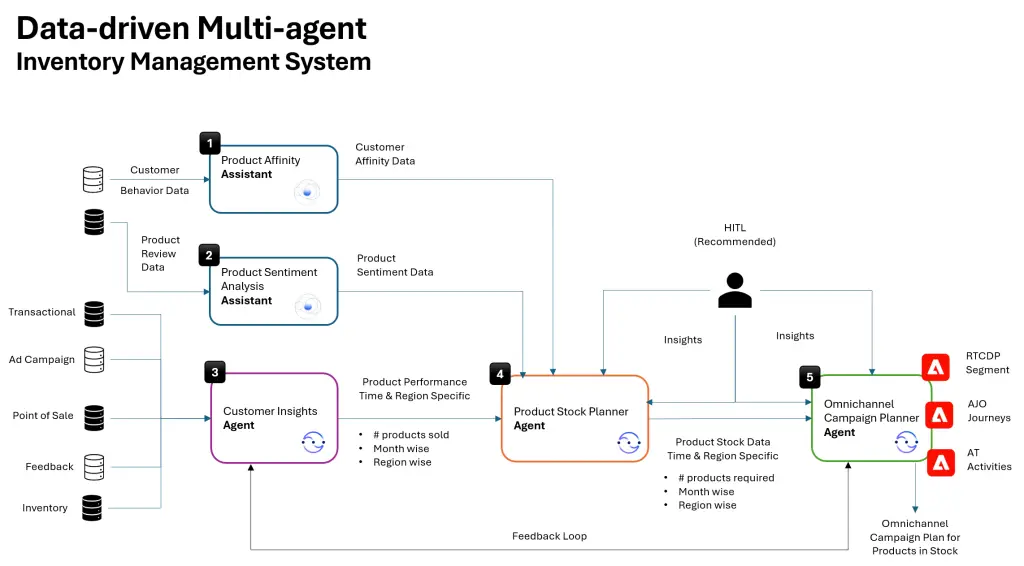
Here is a high-level architecture for you to understand the technical intricacies involved in bringing this to life.
The Product Affinity Assistant (Assistant 1) analyzes behavior data to derive customer affinity metrics, while the Product Sentiment Analysis Assistant (Assistant 2) processes review data to extract sentiment insights.
These insights feed into the Customer Insights Agent (Agent 1), which aggregates them with transactional, point-of-sale, existing inventory data, ad campaign, and campaign feedback data to generate a granular view of product performance — including number of units sold, by month and region.
This data is passed on to the Product Stock Planner Agent (Agent 2), which forecasts product demand and determines the required stock across time and regions. A Human-in-the-loop (HITL) is recommended at this stage to validate and enhance decision-making based on experts’ reviews.
The final output flows into the Omnichannel Campaign Planner Agent (Agent 3), which designs marketing campaigns based on available inventory and stock plans. It integrates with tools like RTCDP, AJO, and AT to execute targeted customer journeys and activities.
A continuous feedback loop ensures that insights from performance outcomes are reintegrated into the system for continuous improvement and inventory optimization.
Finally, what is in it for Retail Leaders, you may ask?
Here you go…
With this multi-agent AI system, your business’s inventory management shifts from being a supply chain function to becoming a customer experience enabler. Connecting the dots between what customers want and what businesses stock, retailers unlock:
- Accurate Stock Forecasting
- Reduced costs
- Fewer stockouts
- Higher Marketing Effectiveness
- Campaigns aligned with real-time availability and customer trends
- Hyper-personalization at Scale
- AI-driven segmentation delivered across every channel
- Operational Efficiency
- Automation of repetitive workflows
- Faster time-to-market
- Increased Revenue
- Matching stock to demand
- Higher conversions and loyalty
The future of retail isn’t about better demand forecasting or smarter marketing—it’s about seamlessly connecting both. With this multi-agentic AI solution, businesses no longer have to choose between operational efficiency and customer-centricity. They can achieve both at scale.
Retail leaders who embrace this model will set the new standard for inventory-aware marketing—where every promotion is relevant, every product is available, and every customer interaction strengthens brand trust.
Good news!
This idea led to achieve an IBM WatsonX Challenge 2025 badge for me as a part of team participated in the challenge across IBM globally.