


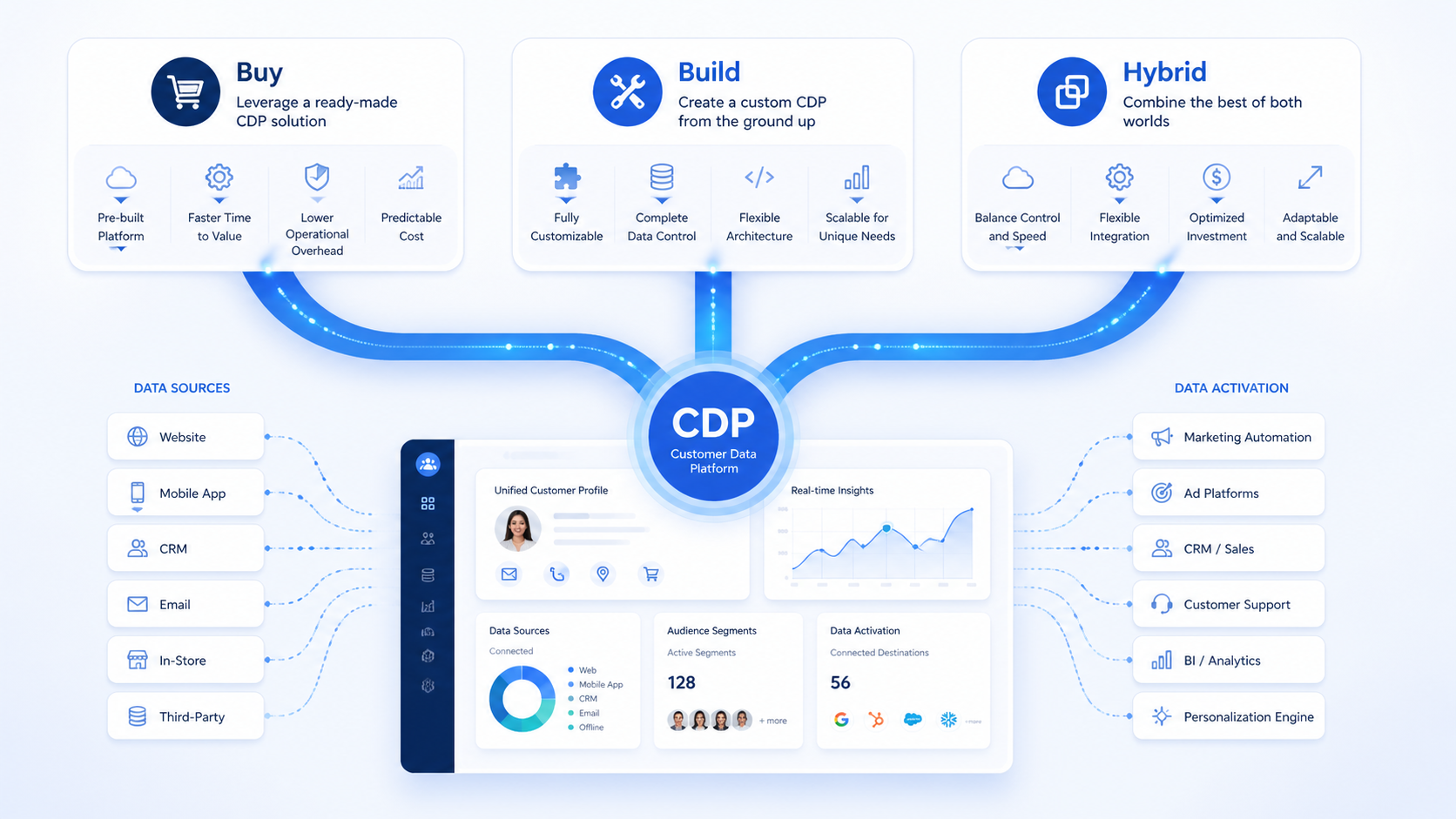
It’s been more than a year now that Gen AI and Agentic AI are no longer just a good-to-have strategy but an essential part of the data and activation ecosystem for enterprises. With recent updates from major MarTech players like Salesforce and Adobe, and the rise of SaaS-to-Agentic AI Systems, it is necessary to make the right data platform investment decisions.
…and the time is NOW!
Why do you need to focus on CDP investments first, and what approaches are available to help you make the right decision for your business?
We shall now look into it.
Read on…
Customer Data Platforms (CDPs) have become the backbone of modern marketing, personalization, and customer experience. Enterprises across industries: retail, banking, telecom, healthcare, travel, and media are investing heavily in unified customer data to drive:
- Real-time personalization at scale
- Secured omnichannel engagement
- AI-driven agentic decisioning
- Marketing efficiency and ROMI to ROI
But one fundamental question continues to shape enterprise strategy:
Should you build your CDP, buy one, or adopt a hybrid approach?
This is not just a technology decision; it is a business transformation choice impacting cost structures, speed, talent strategy, and long-term competitiveness.
In this article, we break down four primary CDP adoption models currently available to us:
- Build Your Own CDP (on your data lake)
- Outsource Build (vendors build CDP on your data lake)
- Buy CDP (run internally)
- Buy + Operate (vendor-managed CDP Ops)
We’ll evaluate them across critical enterprise parameters and conclude with a practical hybrid strategy roadmap.
Forrester identifies the emergence of the “agentic CDP” as the next-generation paradigm, where AI could help CDPs implement new capabilities, generate insights, target audiences, and orchestrate customer journeys. (Forrester, Q1 2026)
The Four CDP Models Defined
- Build Your Own CDP (DIY on Data Lakehouse)
- Outsourced Build (Build-for-You CDP)
- Buy CDP (Operate in-house)
- Buy + Operate (Managed CDP Services)
1. Build Your Own CDP (DIY on Data Lakehouse)
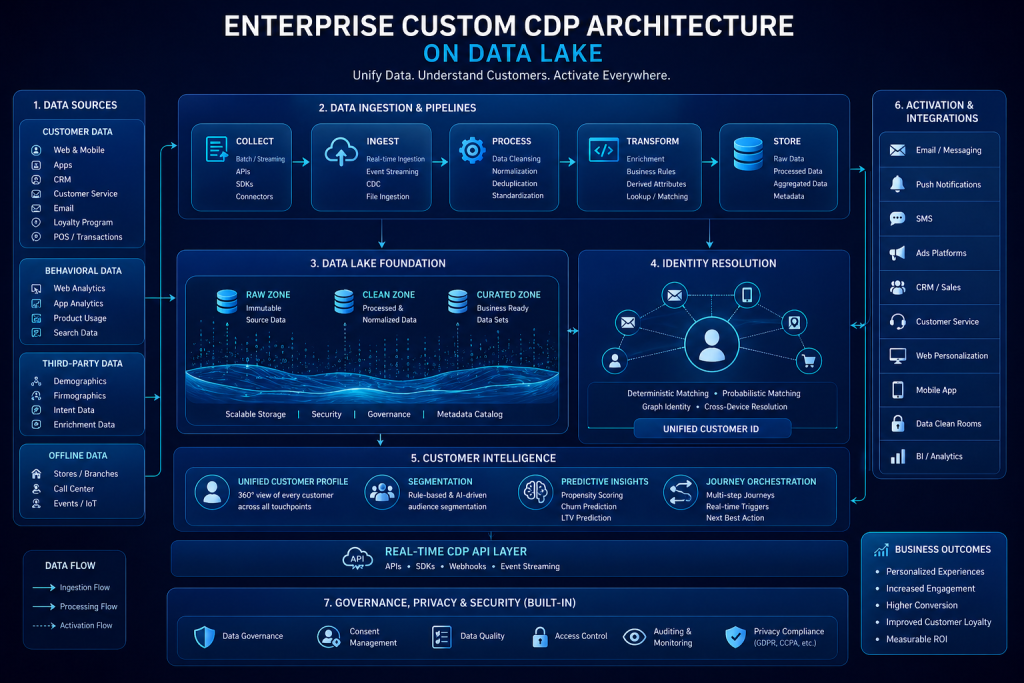
You can make use of your existing Data Lakehouse sits with Snowflake, Databricks, or BigQuery.
Some of the core CDP features, like Identity resolution, Customer profiles, Segmentation engine, and activation pipelines, can be built on top of it.
Below are the high-level services required to build one across the major cloud services:
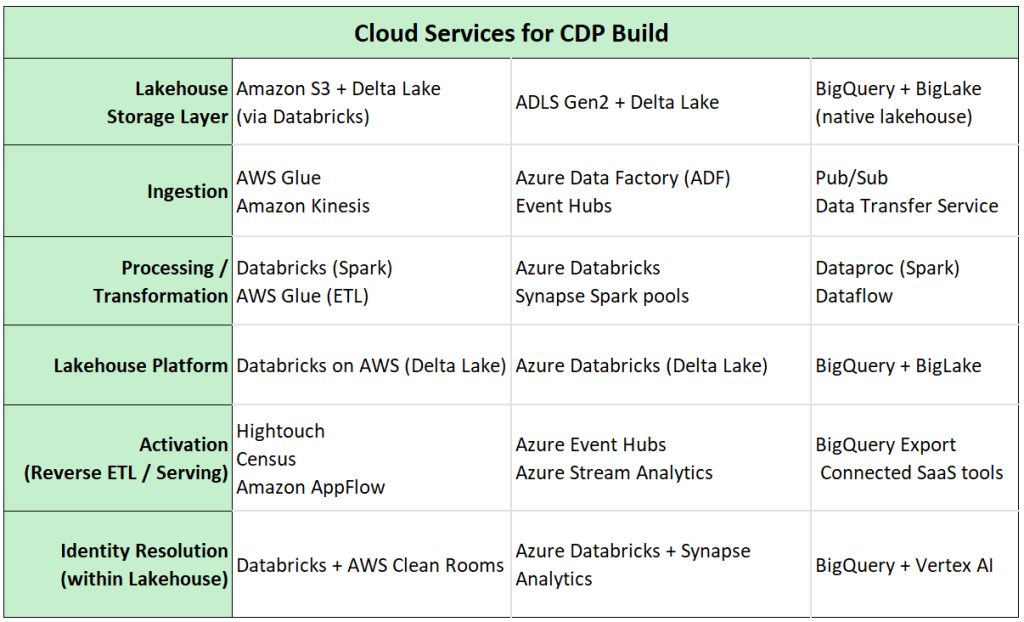
- The main focus of using a data Lakehouse structure is to enable ACID transactions, schema enforcement, and BI-ready data directly in the lake.
- Storage is no longer just S3/GCS/ADLS; it is augmented with table formats or native warehouse engines.
- Compute and storage are tightly integrated (e.g., Databricks, BigQuery, Snowflake)
You are not just building the CDP, you are enabling the Identity resolution engine, Unified customer profile store, Real-time ingestion pipelines, Segmentation engine, Activation connectors (emails, ads, web, mobile), and establishing the governance + privacy layer.
This would typically be done in Snowflake, Databricks, or BigQuery.
Some of the industries, such as Banks, Fintechs, or Telecom giants, where they have a strong Software Engineering DNA team already running Data platforms, ML pipelines, and Real-time systems with a data latency of <500ms.
Pros: When you try to build your own CDPs, you would have full data ownership, extreme customization possibilities, and can make AI differentiation as they allow competitive advantage in advanced use-cases.
Cons: Some of the challenges that many industries that are building their own CDP systems on their data lake or lake houses are: Time to market is slow, marketing teams get blocked due to overengineering and making CDP look like an upgraded version of data warehouse, not as a marketing engine, hidden costs like: Maintenance, debugging pipelines, scaling infrastructure, and compliance updates takes a toll.
Typical users could be:
- Large enterprises with strong data engineering teams
- Tech-first organizations (eg, fintech, digital-native companies)
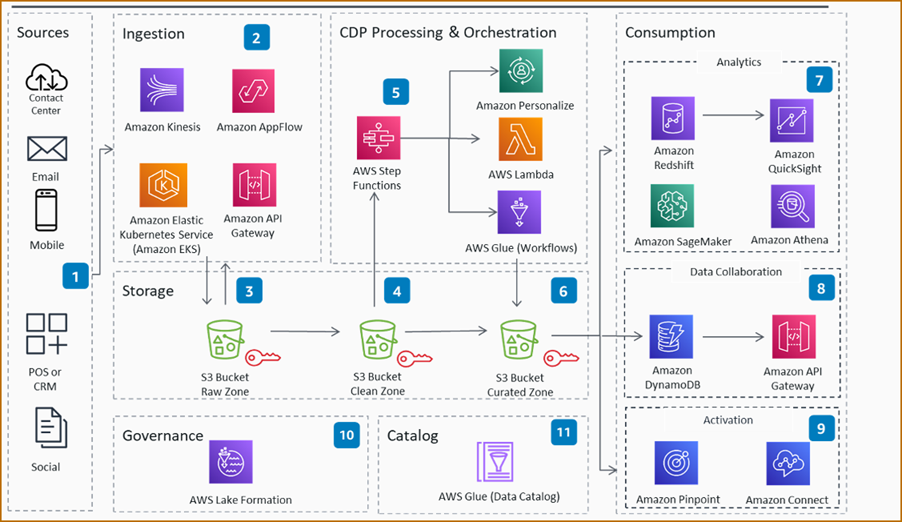
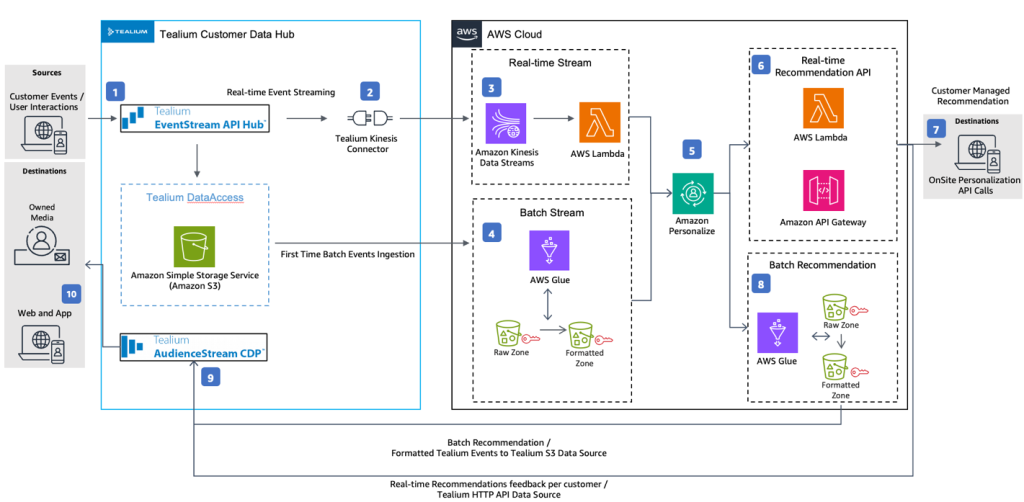
Here is a serverless CDP Architecture that can be built on AWS.
2. Outsourced Build (Build-for-you-CDP)
You are the owner of your Data Lakehouse, but external partners like Accenture, IBM, Capgemini, etc. would be a CDP for you. You can get services on: Designing the CDP architecture, implementing pipelines and models, and sometimes maintaining it for L2-L5 support.
Typical users could be:
- Enterprises with a budget but limited internal expertise
3. Buy CDP (Operate In-house)
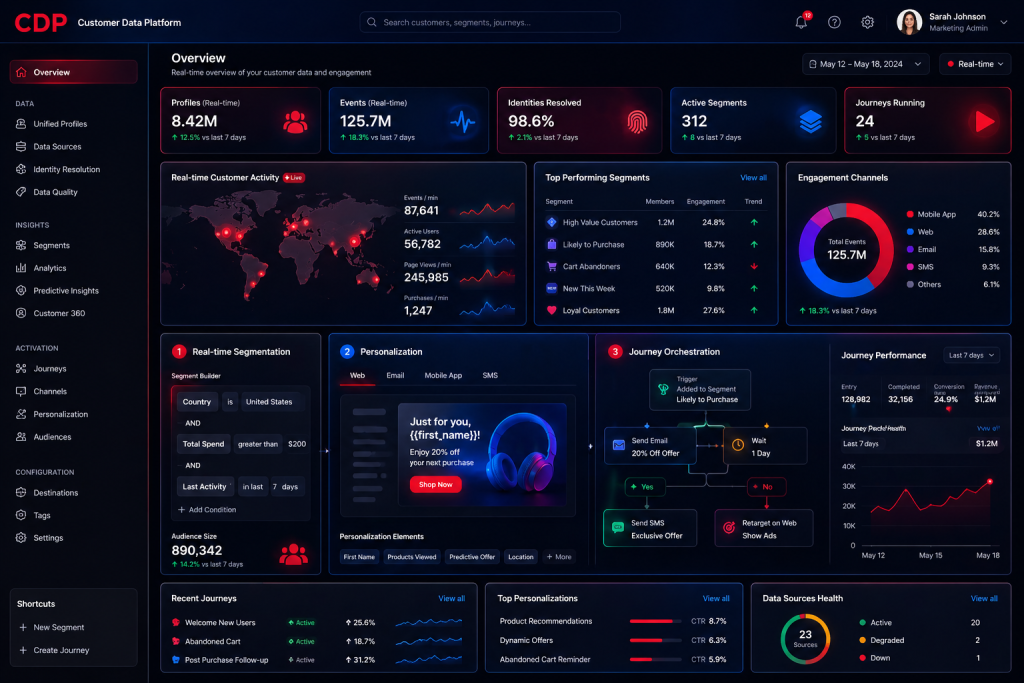
You can directly purchase CDP platforms from Adobe (Adobe Experience Platform), Salesforce (Salesforce Data Cloud), Segment, Treasure Data, Tealium, etc.
Cons: Limited customization, vendor dependency on price lock-in and platform roadmap dependency, the talent gap still exists, and even with CDP skills, the team lacks a business strategy.
Pros:
Enterprises purchasing the CDP platforms from the vendors have seen faster time-to-value. There would be a built-in marketing power with OOTB orchestration, real-time triggers, AI segmentation, and Personalization. Data onboarding is easy, and ID resolution is pre-built. Segmentation is immediate and customizable, not just through the Query but with UI/APIs too, and finally, a proven scalability in processing billions of events, millions of profiles, and real-time decisions.
Typical users could be:
- CDP Power users with solid marketing expertise internally who can run and operate the campaigns on the platforms
4. Buy + Operate (Managed CDP Services)
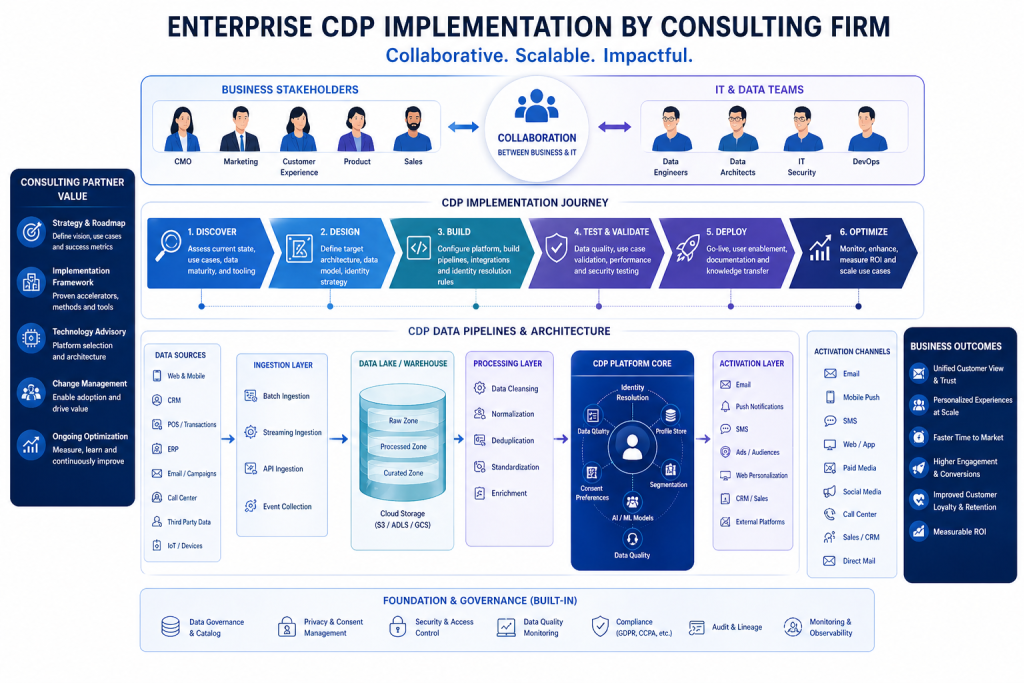
You can buy the product from the vendor and allow it to be managed by the managed service providers like Accenture, IBM, Capgemini, etc. You need to be prepared to bear the expenses associated with platform investments and resource support from the service providers.
You need system integrators, CDP specialists, and MarTech agencies to run the campaigns, journeys, optimization, and experimentations.
We shall now look at the various factors influencing your CDP returns and value realisation.
The CDP market is projected to reach $28.2B by 2028 (CAGR 39.9%)
According to the Customer Data Platform Institute:
- Over 70% of large enterprises have implemented or are planning CDPs
- CDP adoption has grown 3x in the last 5 years
Meanwhile, research from Gartner highlights that:
- 89% of companies compete primarily on customer experience
The global CDP market is projected to grow from USD 37.11 billion by 2030, at a CAGR of 30.7%
But here’s the real challenge:
How should enterprises implement a CDP?
Here is a comprehensive comparison across enterprise parameters of various adaptation strategies:
But here’s the real challenge:
How should enterprises implement a CDP?
Here is a comprehensive comparison across enterprise parameters of various adaptation strategies:
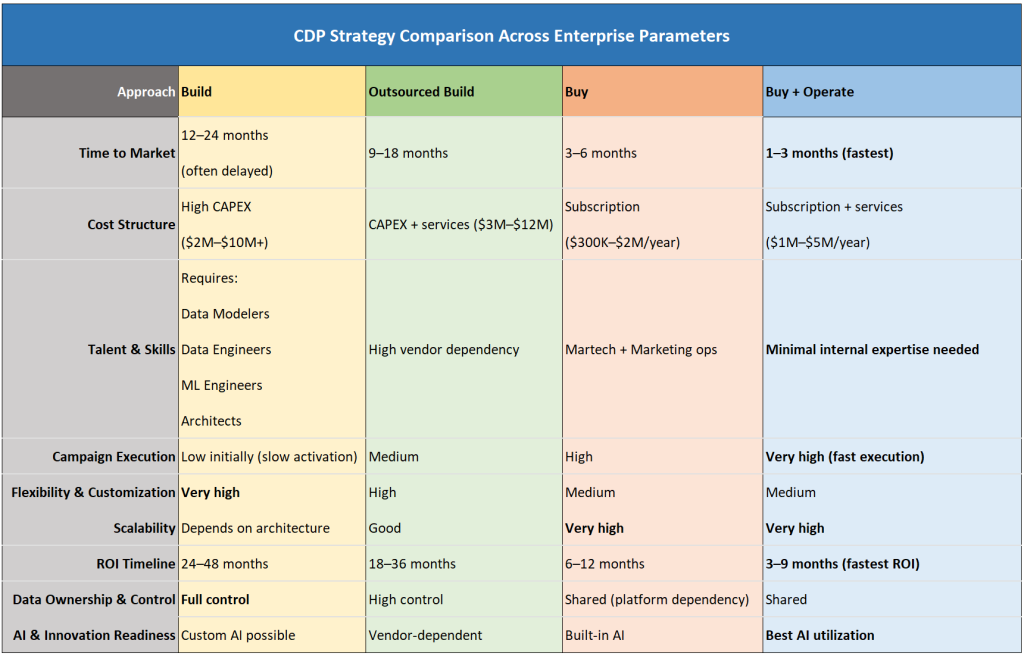
Key Insights:
- Speed matters: Long build cycles can cause missed revenue opportunities (especially in seasonal industries like retail).
- Hidden costs in Build: Maintenance, upgrades, and talent often make it more expensive than expected.
- Activation is the bottleneck: Success depends more on marketing execution than just data infrastructure.
- Fastest value realization: Buy + Operate consistently delivers the quickest time-to-value and ROI.
Note: CDP is not just building the data platforms but is heavily dependent on analytics and activation use-cases to make your data work for your business and move the needle of your revenue clock in a clock-wise direction.
Example Platforms: Modern CDP platforms like Adobe and Salesforce typically support:
- Predictive segmentation
- Lookalike modeling
- Real-time decisioning
“Companies using CDPs are 2.5x more likely to outperform competitors in revenue growth.”
~ WorldMetrics, 2024
We shall now look at the various adoption approaches across the industries and how it is affecting their overall marketing and analytics performance.
#1 Retail & Commerce:
Buy + Operate is the most suitable approach for their rapid campaign execution cycles (daily/weekly). They are heavily dependent on hyper-personalization at scale. Brands need strong pre-build integrations for their downstream systems activation, like Ads, Email, and CRM.
- Sephora uses Salesforce for personalization and loyalty orchestration.
- Nike leverages Adobe Experience Cloud for customer journeys.
Retail prioritizes speed to activation over control, making Buy + Operate the clear winner.
#2 Banking & Financial Services
Build + Buy Hybrid is best suited for the banking and financial services sector due to strict compliance (GDPR, RBI, etc.). It requires control over PII and Risk models. A strong requirement to separate the data layer (internal) and the activation layer (external).
- JPMorgan Chase builds internal data platforms but uses external tools for marketing orchestration.
- HSBC has invested heavily in internal data lakes while partnering with SaaS platforms for engagement.
Banks optimize for control + compliance, not speed. Analytics-heavy operations require data to sit in an internal data Lakehouse. They do rely upon CDP SaaS in activating the audiences, especially at TOFU and MOFU, and focus on BOFU user activation via internal systems of activation.
#3 Telecom
Outsourced Build + Buy is the approach they generally adopt for their extremely large-scale data (billions of events per day). Heavy legacy infrastructure requires a lot of system integration experts.
- Vodafone partners with vendors for data platforms and uses SaaS for engagement.
- AT&T combines internal data engineering with external MarTech ecosystems.
Telecom balances scale + modernization, often relying on partners to accelerate transformation.
#4 Healthcare
Build or Outsourced Build, works more like a collaborative approach, as the industry is heavily dependent on guarded data with global privacy and policy like HIPAA. Need for strict governance and auditability. Limited tolerance for data exposure. If at all, if they still would like to adopt the Buy approach, they would generally focus on BOFU and TOFU audiences only with their MarTech eco-system for data activation.
- GSK deployed Tealium across 50+ Global Website Properties
- UnitedHealth Group builds proprietary analytics platforms.
Healthcare organizations allocate billions annually to data + AI, often internally controlled.
#5 Travel & Hospitality
Buy + Operate is a suitable option for travel and hospitality, as this requires a strong need for loyalty-driven personalization, revenue tied to repeated bookings, and seasonal demand cycles.
- Marriott International uses Salesforce for customer engagement.
- Hilton leverages digital platforms for loyalty personalization.
I would also want to highlight the pros and cons of each approach for you to make the right decision for your business.
Here is the table summarising the decision matrix for the industries to adopt CDP into their MarTech eco-system.
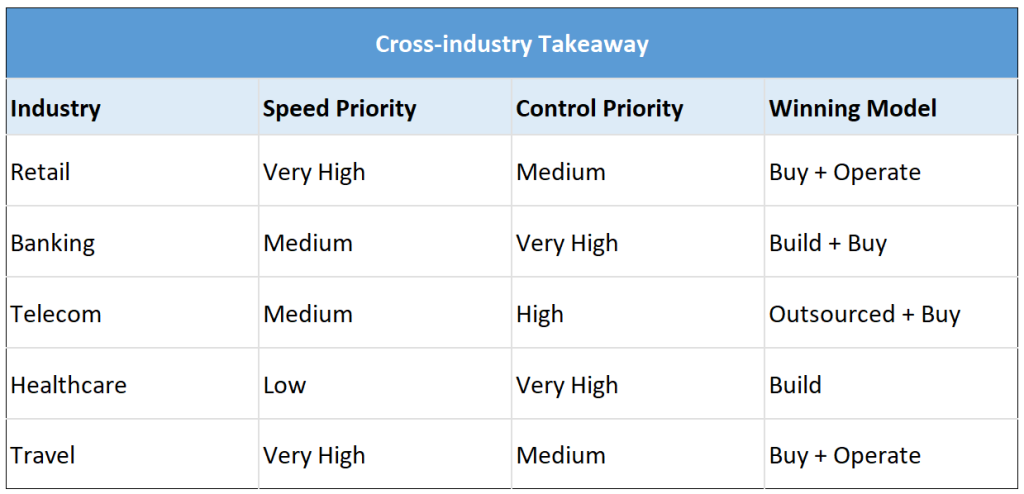
Final Perspective:
- If revenue depends on marketing speed, then Buy + Operate wins.
- If risk & compliance dominate, Build or Hybrid wins.
- If scale + legacy complexity, the better choice is Outsourced Build.
We also need to look at the existing picture of how CDP is doing with the current adoption across the industries. Below are the challenges that still exist, and we shall also discuss the ways to mitigate these issues:
- Data Silos still persist even after CDP implementation: Poor data governance and lack of unified identity.
o Establish a clear identity resolution strategy
o Create a data governance layer (not optional)
Note: Most CDPs fail here because governance is treated as a side task instead of a core program
- Activation gap: CDP exists, but campaigns don’t scale.
o Build “last-mile activation pipelines.”
o Shift ownership to marketing (not just data teams)
Note: Activation fails when CDP is treated as a data project instead of a revenue engine.
- Talent shortage: MarTech expertise is rare; individual talents are affected by skill gaps or other dark sides of the industry.
o Adopt a “Buy + Operate” or partner-led model
o Create a Hybrid Team Structure
o Upskill Existing Teams
o Build a Center of Excellence (CoE) - Overengineering the build: Companies are trying to build “perfect systems” that are never fully utilized.
o Start with Use Cases, Not Architecture
o Follow the “80/20 Rule”: Deliver 80% value with 20% complexity
o Implement in Phases
o Define “Time-to-Value” KPIs: First campaign in 30-60 days, measurable impact in 90 days.
Personal Recommendation:
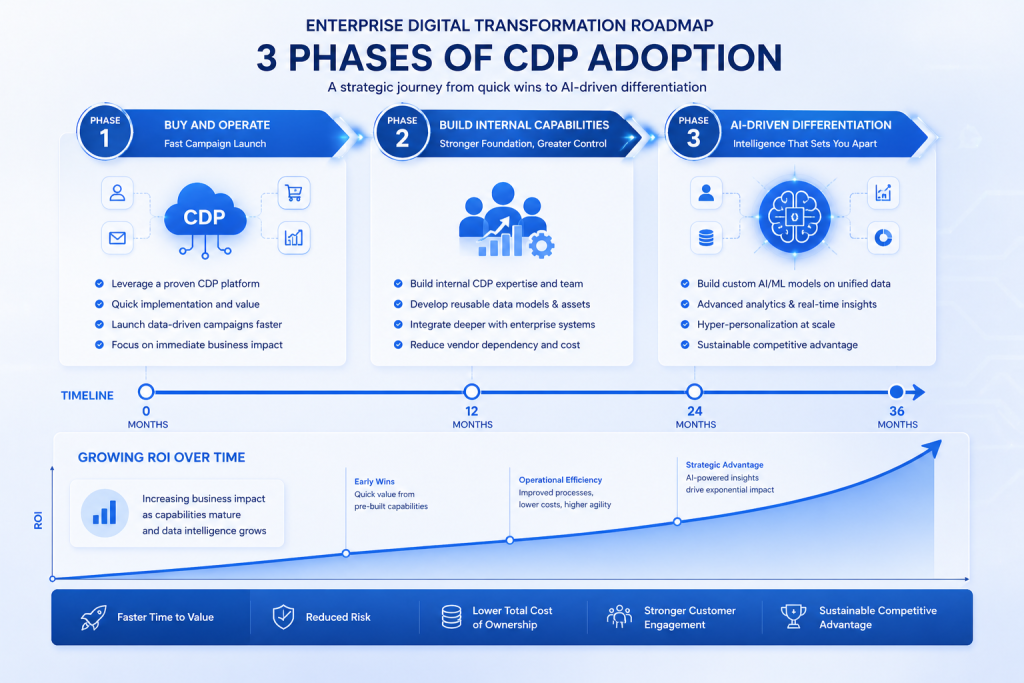
General advice is that No One Size Fits All, but from a business perspective, business runs on Sales. If the customers paying for CDP products or CDP services can’t see positive returns within 6-12 months no point in investing in any of the data-centric choices, either for analytics or operational.
Go for a winning hybrid strategy with incremental stacking, one model at a time. This follows a hybrid approach for an enterprise to adopt CDP into its MarTech ecosystem.
Phase 1:
Launch campaigns quickly within the first 6-8 months with the Build + Operate model. Generate a decent ROI.
Phase 2:
Build internal teams within 6 months and build capability within 18 months to reduce the dependency on external partners, vendors, or agencies.
Phase 3:
Try to add extensions via custom data models and AI differentiation within 12-36 months.
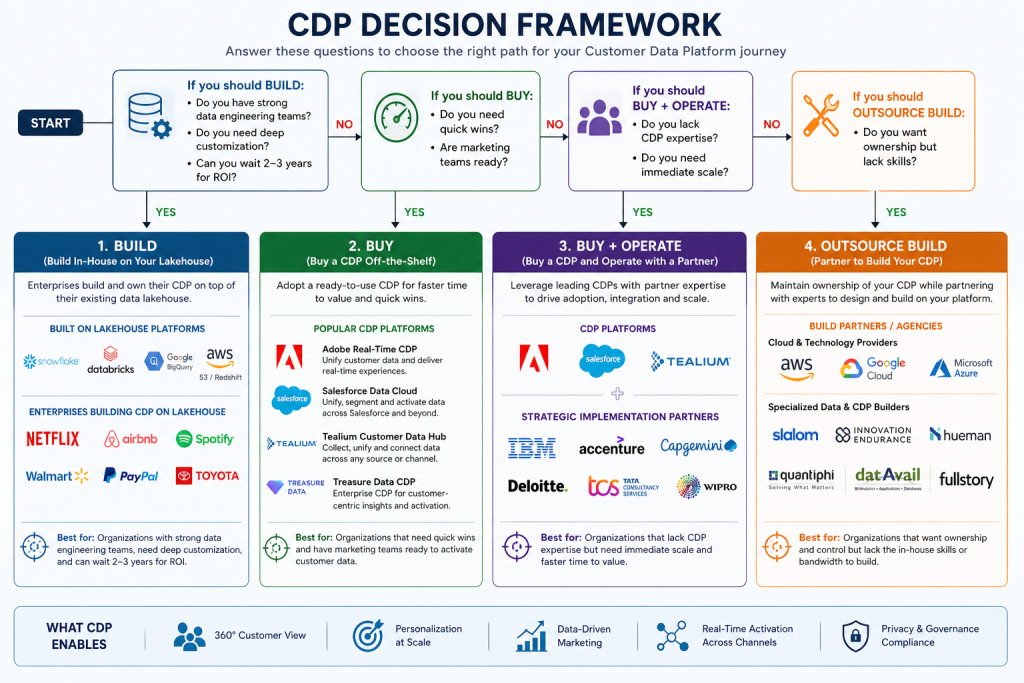
Use the decision tree below to fine-tune your decision-making.
Decision Tree to help you navigate the chaos:
BONUS:
Tealium Delivers Cross-channel Customer Experiences with Amazon Personalize. Here is a high-level architecture of Tealium + AWS. More read here: https://aws.amazon.com/blogs/industries/tealium-delivers-cross-channel-customer-experiences-with-amazon-personalize
Conclusion:
I would say: Start fast (Buy), Learn quickly (Operate), Differentiate smartly (Build).
