


Enterprises are shifting their marketing transformation strategy towards autonomous agents. AI Agents for Marketing would be available to take actions 24×7 towards the marketing goals and objectives in align with the strategic development of personalization, content creation, marketing automation, omnichannel campaign management, digital advertising, journey orchestration, and digital analytics use-cases.
There had been a time when in an enterprise, agency, or startups multiple teams coming together brainstorm new ideas with a bubbling creativity, working towards a common goal with a specific action plan in mind. Now! it is the time that AI Agents for MarTech would help the brands with the activities each team used to perform seamlessly. All we have to provide Marketing AI Agents is that the required memory and tools to perform the actions required to achieve the marketing objectives and goals.
AI Agents can impact positively across:
- Analysing vast amounts of data for actionable insights
- Hyper personalization
- Campaign optimization
- Automating monotonous tasks
- Advanced segmentation
- Content creation
- Omnichannel orchestration workflows
- Continuous learning of customer behaviour
- Agile enterprise marketing strategies
- Customer journey mapping
- Lead generation and nurture
- Laser targeting audience with advertising
- Loyalty campaigns
- Marketing automation
Agentic MarTech are impacting:
- Improved campaign performance
- Marketing cost reduction
- Increase in ROMI
- Scalability
- Rapid Implementation of creative variations
- Best customer experience delivery
Let us take a brief look at how we have arrived here from AI to Chatbots to Gen AI Assistants to Enterprise Digital Transformation AI Agents.

1950: Alan Turing – Machine Intelligence
Alan Turing’s 1950 paper titled “Computing Machinery and Intelligence“, published in the journal Mind, is one of the most foundational works in the history of artificial intelligence.
Turing proposed to reframe this ambiguous question with a more testable one: “Can a machine imitate a human so well that a human interlocutor cannot reliably tell the difference?“
Turing predicted that: “In about 50 years’ time… one will be able to speak of machines thinking without expecting to be contradicted.” This bold forecast was partially realized in the emergence of natural language models, chatbots, and AI agents that pass limited forms of the Turing Test.
1956 and the Birth of AI
In 1956, the term “Artificial Intelligence” (AI) was officially coined by John McCarthy in Dartmouth Conference, a pivotal moment in the history of computer science and cognitive simulation.
McCarthy drafted the proposal stating: “The study is to proceed on the basis of the conjecture that every aspect of learning or any other feature of intelligence can in principle be so precisely described that a machine can be made to simulate it.” This was the first formal definition of AI as a scientific field.
1966: ELIZA and Early Chatbots
In 1966, Joseph Weizenbaum, a computer scientist at MIT, developed ELIZA, one of the first chatbots—a landmark in the history of artificial intelligence and natural language processing.
In MIT Artificial Intelligence Laboratory, he created a rule-based natural language processing program. Simulated a Rogerian psychotherapist by responding to user inputs using pattern-matching and scripted responses.
This was the first program to simulate human-like conversation. It demonstrated that simple algorithms could mimic human dialogue, at least superficially.
1997 – Garry Kasparov Defeated by IBM’s Deep Blue
Garry Kasparov, world chess champion defeated by IBM’s Deep Blue, a chess-playing supercomputer. This was a major AI victory in a highly strategic, combinatorially complex game.
Brute-force search algorithm with extensive computing power: Evaluated 200 million positions per second. Used a huge database of human games and opening/endgame strategies.
This showed that machines could outperform humans in intellectual, rule-based games.
2011 – IBM Watson Defeats Jeopardy! Champions
IBM’s Watson AI system defeated two of the greatest Jeopardy! Players; Ken Jennings and Brad Rutter—using a combination of natural language processing (NLP), machine learning (ML), and information retrieval.
This demonstrated that AI could understand and respond to natural human language at expert-human levels. It showed the power of hybrid AI systems (NLP + IR + ML) in structured Q&A. Also, marked a shift from symbolic AI (rules and logic) to data-driven AI.
Natural Language Processing interpreted complex, nuanced Jeopardy! clues. Information Retrieval searched vast internal databases of encyclopaedias, dictionaries, news, Wikipedia, etc. Machine Learning ranked possible answers and chose the most likely correct one based on confidence scoring. Most important thing to note here is that all responses were generated from preloaded data, not live web searches.
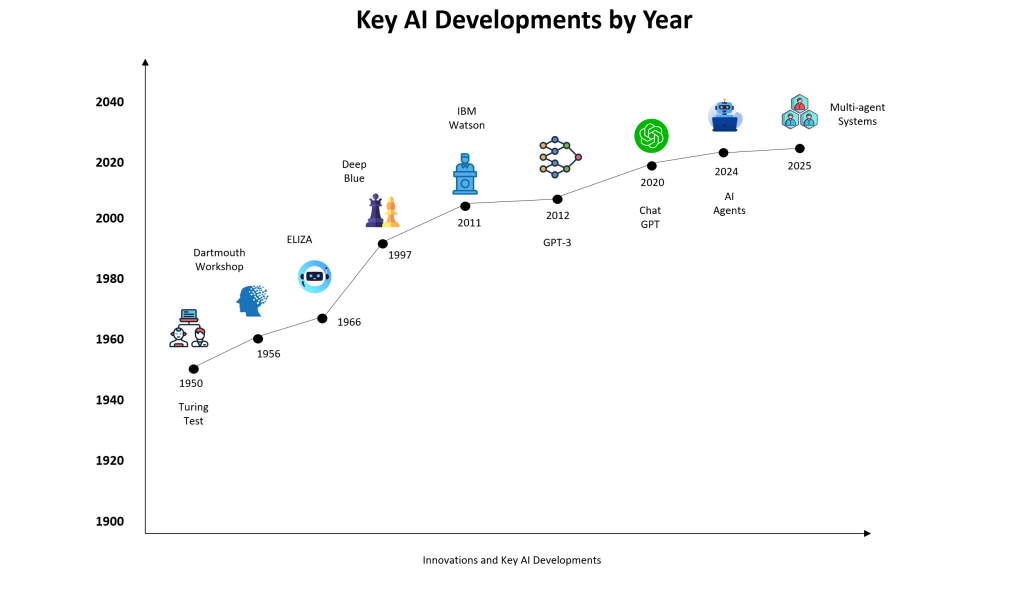
2012 – AlexNet: The Deep Learning Revolution Begins
The AlexNet model, developed by Alex Krizhevsky, Ilya Sutskever, and Geoffrey Hinton, won the ImageNet Large Scale Visual Recognition Challenge (ILSVRC) by a massive margin, sparking the modern deep learning revolution, especially in computer vision.
AlexNet reduced the top-5 classification error rate on ImageNet from 26% to 15%, a huge leap at the time.
This lead to some of the major innovations such as:
- Convolutional Neural Networks (CNNs) modelled after the visual cortex, excellent for image recognition.
- ReLU Activation Function led to faster training compared to traditional sigmoid/tanh.
- Using NVIDIA GPUs accelerated to train on millions of images—cut training time drastically.
- Dropout Regularization helped reduce overfitting, improving generalization.
- Deep Architecture of 8 layers used which was deeper than typical models at that time.
2020 – GPT-3: Language Generation Breakthrough
OpenAI released GPT-3 (Generative Pre-trained Transformer 3), a powerful autoregressive language model with 175 billion parameters, marking a new era in natural language understanding and generation. It built on its previous models (GPT-1 in 2018, GPT-2 in 2019)
This had a massive leap in fluency and contextual understanding of human language. GPT 3 enabled the rise of AI-powered content creation, coding assistants, and chatbots. It made foundation models mainstream—one model serving multiple applications.
2022 – ChatGPT: Natural, Context-Aware Dialogue at Scale
OpenAI launched ChatGPT, a conversational AI built on GPT-3.5, capable of engaging in human-like, context-aware dialogue with broad real-world utility.
Some of the real-world applications that GPT 3.5 lead to are:
- Business automation (customer support, content creation)
- Education (tutoring, Q&A, explanations)
- Software development (code generation & debugging)
- Creative work (poetry, story writing, brainstorming)
- Research & data analysis
One of the major milestones in the digital business industry is that this acquired 1 million users in just about 5 days! This made Large-Language-Model (LLM) to be adopted by mainstream.
2024 – AI Agents: The Rise of Autonomous, Goal-Driven Intelligence
In 2024, AI Agents emerged as a transformative leap from passive chatbots to autonomous, proactive systems capable of goal-setting, planning, decision-making, and acting across digital environments.
The key components of Modern AI Agents:
- The core language and reasoning engine are LLMs
- Stores user data, decisions, and preferences across sessions at the memory layer
- Tool usage would be from APIs, databases, web search, apps, etc.
- Planning module would take care breaking down goals into executable tasks
- Action executors through run code, send emails, data manipulation, and system update
AI Agents move beyond chat interfaces to task-completing digital co-workers. Agents enable automation of complex workflows across business domains. Critical to building agentic ecosystems for customer support, marketing, research, and operations.
Couple of the popular frameworks available currently are:
1. LangGraph: graph-based agent orchestration
2. CrewAI – role based multi-agent collaboration.
2025 – Multi-Agent AI Systems: The Dawn of Collective Artificial Intelligence
In 2025, multi-agent AI systems emerged as the next evolution of agentic AI, mirroring social intelligence by enabling collaborative, autonomous agents to handle complex, interdependent tasks, from an enterprise automation to real-world simulations.
We will look into more detailed information about AI Agents and Multi-agent AI systems in the upcoming topics for now below are the key features and capabilities:
Multi-agent system features:
- Multiple autonomous agents
- Communication and collaboration
- Collective reasoning
- Feedback loops
- Environment-aware
Core capabilities:
- Role-based task allocation
- Task planning and scheduling
- Knowledge sharing among agents
- Long-term memory and persistent context
- Distributed execution and parallel processing
Multi-agent system scales AI from task-doers to digital collaborators. This enables complex project execution autonomously. It mirrors human teamwork and organizational structures. Transitions from core to future digital workforces, autonomous simulations, and hyper-personalized user experiences.
"Expected CAGR growth rate is around 30.6% from 2025 with expected market growth is about USD 2407.02B by 2032"

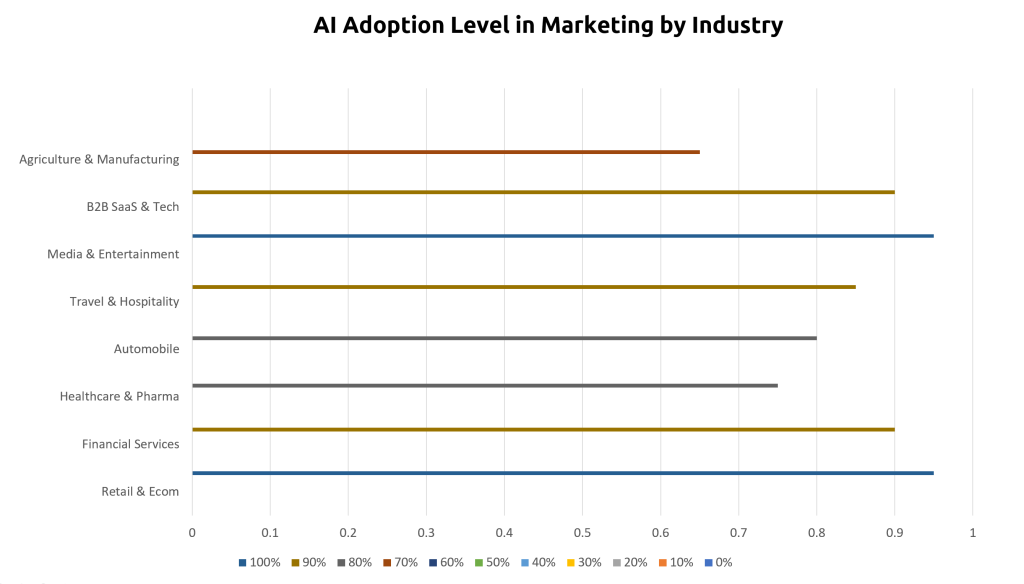
Here’s is a breakdown of AI adoption level in Marketing by Industry
"$7.9T is the economic worth of Gen AI"

AI Agents – Technology: How does it work?
Before we dive into the Technology and the ways of working of AI Agents, it’s a good idea to touch upon it’s core capabilities for which it is said to be called as ‘AI Agents’.
Let us look into them one by one.
AI Agents Characteristics | Definition | Implication | Example |
Autonomy | Operates without human intervention | Makes decisions and acts independently | Agent triggers a campaign based on user behavior without manual input |
Reactivity | Responds to changes in the environment | Adapts actions based on real-time data | Detects churn signals and adjusts customer journey |
Proactivity | Takes initiative to achieve goals | Anticipates needs or events before they happen | Suggests upsell products before checkout |
Social Ability | Communicates with humans or other agents | Enables coordination and collaboration | Exchanges data with a content agent to personalize messaging |
Learning Capacity | Improves through data and feedback | Continuously optimizes performance | Learns the best time to send marketing emails |
Persistence | Maintains context/state over time | Handles long-term, multi-step tasks | Remembers user’s previous actions across sessions |
Gen AI to AI Agents to Agentic AI: Comprehensive Comparison
Many would get confused between Gen AI, AI Agents, and Agentic AI. Sometimes they misuse these terms. Let us now look into the key characteristics and what makes each of them unique with some use-cases as examples.
Definitions:
Generative AI: Models that generate new content (text, images, audio, code) based on patterns in training data.
AI Agents: Goal-driven entities that use AI to sense, plan, act, and learn in a defined environment. Consider it to be more focused on workflow orchestration with Gen AI capabilities geared towards achieving the set goal autonomously.
Agentic AI: A system of one or more AI agents with autonomy, memory, reasoning, and coordination to pursue complex goals over time.
Capabilities:
Below is the capability comparison table for Gen AI, AI Agents, and Agentic AI.
Capability | Generative AI | AI Agents | Agentic AI |
Autonomy | Low – reactive prompts | Medium – follow goals/tasks | High – multi-step reasoning, dynamic planning |
Goal Orientation | No (user gives prompt) | Yes (completes predefined task) | Yes (pursues evolving goals over time) |
Memory | Stateless (unless engineered) | Short-term/task-level memory | Persistent memory (long-term context) |
Planning | None or limited | Simple, linear planning | Complex, recursive, dynamic planning |
Coordination | N/A | Single agent | Multi-agent collaboration and delegation |
Learning | No self-learning | Task-specific, limited learning | Can adapt based on feedback, memory, context |
Features:
Below is the feature comparison table for Gen AI, AI Agents, and Agentic AI.
Feature | Generative AI | AI Agents | Agentic AI |
Prompt-based | ✅ Yes | ⚠️ Sometimes | ❌ Rare |
Self-directed task execution | ❌ No | ✅ Basic | ✅ Advanced |
Context awareness | ❌ Minimal | ⚠️ Basic (task scope) | ✅ Persistent context (across tasks) |
Tool usage (APIs, DBs, etc.) | ⚠️ With orchestration | ✅ Task-specific tools | ✅ Multi-tool with dynamic invocation |
Multi-agent coordination | ❌ No | ❌ Typically single | ✅ Yes |
Human-in-the-loop | ✅ Often required | ⚠️ Sometimes | ❌ Often optional, fully autonomous |
Example Tools | ChatGPT, DALL·E | LangChain agent, AutoGPT | CrewAI, LangGraph, Meta LLaMA Agents |
If you ask me, when to use what, here’s the solution:
When you want to generate text content or image quickly, go for Gen AI. For automating repeatable tasks to achieve a goal AI Agent works best. If you are trying to solve the complex problems then Agentic AI is the go-to solution.
Autonomous AI Agents: Architecture
We shall now look into the architecture designs of single AI Agent and Multi-agents.
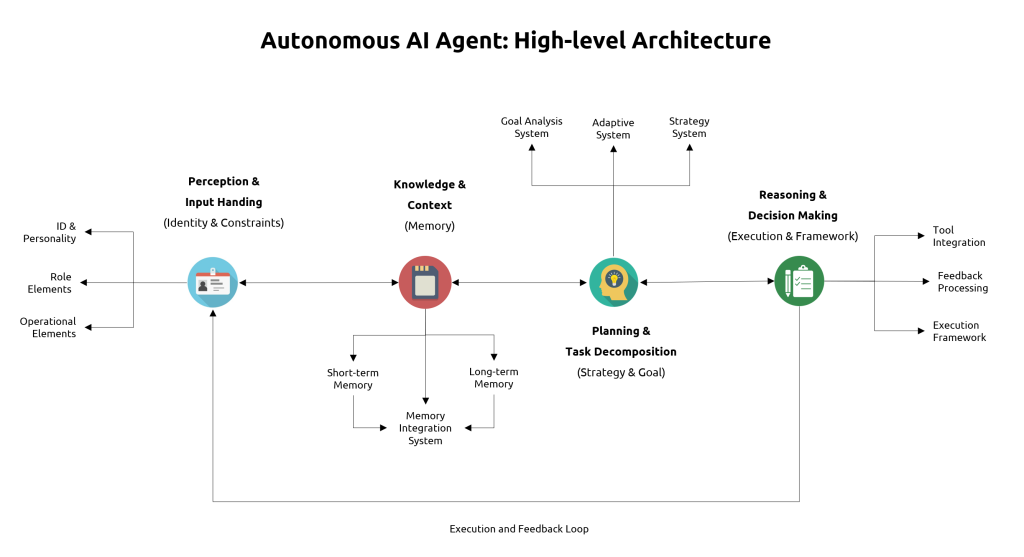
1. Perception & Input Handling (Identity & Constraints)
This step is to understand the inputs, define identity or personality, and establish role boundaries. Here you define what your agent is about and what it should be performing or not autonomously.
- ID & Personality: Defines the agent’s behavior style, communication tone, and persona (e.g., helpful support agent vs. assertive strategist).
- Role Elements: Sets boundaries based on the agent’s functional scope (e.g., marketing analyst, journey optimizer).
- Operational Elements: Real-world constraints like data limits, time restrictions, compliance rules.
This step feeds into the Memory and context generation.
2. Memory (Knowledge & Context)
Memory helps to Store, retrieve, and integrate relevant information across interactions and tasks.
- Short-Term Memory: Holds immediate context (current conversation or task or previous prompt history).
- Long-Term Memory: Retains persistent knowledge (customer profiles, past tasks, preferences).
- Memory Integration System: Manages what to retain long-term vs. discard, enabling context continuity and learning over time.
You then feed the memory to the Planning & Task Decomposition and Perception Loop.
3. Planning & Task Decomposition (Strategy & Goal)
The purpose is to break down goals into actionable subtasks with prioritization and sequencing.
- Goal Analysis System: Understands the overall objective (e.g., “improve customer engagement”) and translates it into measurable milestones.
- Strategy System: Creates execution plans based on memory, constraints, and input.
- Adaptive System: Adjusts the plan dynamically in response to feedback or new inputs.
Reasoning & Decision Making for execution would be taken care with planning and tasks fed into the system.
4. Reasoning & Decision Making (Execution & Framework)
This is an execution phase where the plans are intelligently executed using tools, evaluate feedback, and update knowledge or actions.
- Tool Integration: Interacts with APIs, databases, platforms (e.g., Adobe Experience Platform, Salesforce).
- Feedback Processing: Evaluates outcomes and results (e.g., did the journey trigger work?), then loops back into memory and planning.
- Execution Framework: Orchestrates tasks, handles edge cases, and ensures timely execution.
This phase feeds into the Continuous Execution & Feedback Loop that refines performance.
5. Execution & Feedback Loop
Ensures continuous improvement by feeding execution outcomes back into:
- Memory (to learn)
- Planning (to adjust)
- Perception (to align role/context)
This loop is what gives the agent its agentic behavior: the ability to learn, adapt, and act autonomously.
Imagine all the above steps are happening across each of the agents and agent can collaborate with each other seamlessly to achieve the set out marketing goals.
That’s what the Multi-agent Systems would do!
Below is the reference architecture diagram for multi-agentic ai systems:
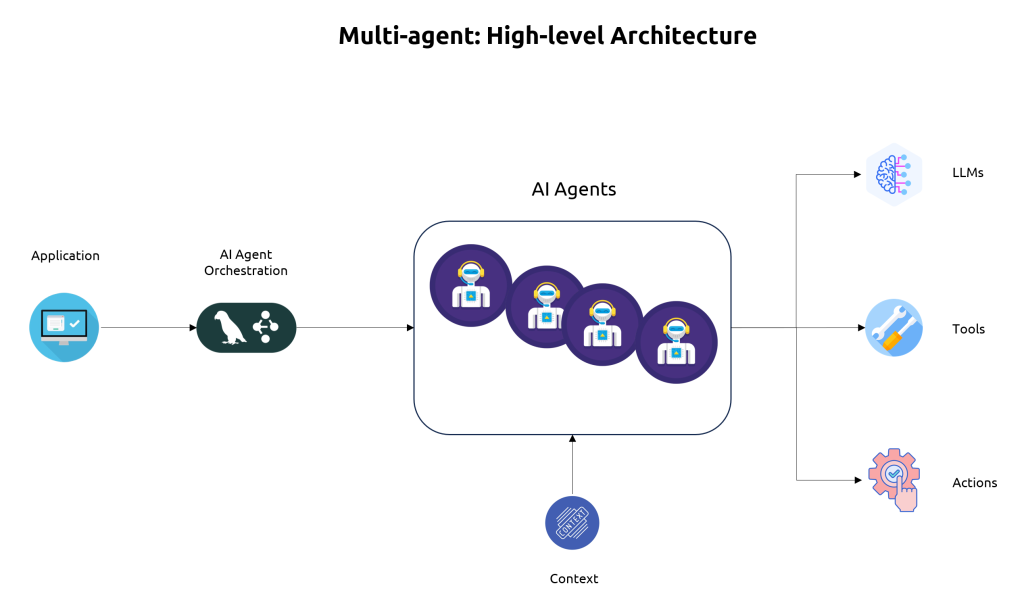
This Multi-agent High-level Architecture diagram illustrates how a system of AI agents is orchestrated to complete tasks autonomously using large language models (LLMs), contextual data, and external tools.
Here’s a breakdown of each key component:
1. Application
External interface (e.g., web app, enterprise system) that interacts with the AI system by sending requests or tasks to be executed. Entry point for user or system inputs into the AI agent framework.
2. AI Agent Orchestration
The control layer that routes tasks to the appropriate agents and coordinates their interactions. Decides which agent(s) to activate, manages parallel or sequential flows, and ensures cohesive multi-agent collaboration.
3. AI Agent(s)
Individual autonomous agents, each with a defined role (e.g., planner, researcher, executor). Process contextual information, invoke LLMs or tools, and contribute to the final outcome collaboratively or independently.
4. Context
Shared and agent-specific data that informs reasoning and decision-making (e.g., task history, environmental data, user profiles). Provides memory and situational awareness to guide agents intelligently.
5. LLMs (Large Language Models)
Foundation models (e.g., GPT-4, Claude) that assist agents in understanding language, reasoning, and generating responses. Power natural language understanding, planning, summarization, and decision-making.
Tools
External systems, APIs, or services that agents can use (e.g., data fetchers, automation platforms, analytics engines). Enable action execution beyond language (e.g., sending an email, updating a CRM, fetching data).
Actions
Final outputs or real-world executions resulting from agent collaboration (e.g., triggering campaigns, updating dashboards). Deliver measurable business or user outcomes based on the original application request.
Here’s a wonderful video explaining Large-language-model internal workings:
Top Agentic AI Use-cases : Enterprise Marketing
Here is a list of Gen AI, AI Agents, and Agentic AI use-cases for Enterprise Marketing:
Its crucial to know when to implement what by understanding how important and urgent is to implement the use-cases based on the business requirements. Setting the right priority is the first step in crafting AI strategy for your marketing goals.
Domain | Generative AI | AI Agents | Agentic AI |
Marketing | Ad copy generation | Campaign builder agent | Cross-channel journey optimization assistant |
Customer Support | Response generation | Auto-ticket triage agent | End-to-end customer resolution across systems |
Analytics | Summary reports | Dashboard builder agent | Adaptive insight agent that evolves with KPIs |
Sales | Proposal generation | Lead qualification agent | Revenue operations assistant with quota planning |
Engineering | Code generation | Auto-debugging agent | Product lifecycle assistant coordinating QA + releases |
Let’s looks at some of the top enterprises using Gen AI to Agentic AI for their marketing adoptions.
1. Gen AI: Enterprise Marketing Use-cases
Content Generation at Scale
Automate blog posts, ad copy, email campaigns, social media captions.
HubSpot on Generative AI in Marketing
Personalized Product Recommendations
Create tailored suggestions based on customer behavior and preferences.
Salesforce: Personalization with GenAI
Dynamic Creative Optimization (DCO)
Auto-generate visual and text variants of ads in real-time.
Adobe on Creative AI
SEO Content Optimization
Use AI to analyze top-ranking pages and generate optimized content.
Semrush: Gen AI & SEO
2. AI Agents: Enterprise Marketing Use-cases
Chatbots & Virtual Shopping Assistants
Engage customers, answer queries, and guide purchases 24/7.
Drift: Conversational AI for Marketing
Lead Qualification Agents
Automate lead scoring and qualification based on CRM/behavior data.
Tidio: AI Chatbots for Lead Generation
Email Follow-up Agents
Schedule and personalize automated email follow-ups.
Mailmodo: How AI improves email workflows
Customer Journey Optimization Agents
Coordinate personalized messages across web, email, and app touchpoints.
Twilio Segment + AI
3. Agentic AI: Enterprise Marketing Use-cases
Autonomous Campaign Orchestration
AI agents design, launch, and optimize multichannel campaigns with minimal input.
Gartner on Agentic AI
Customer Lifecycle Managers
AI agents manage entire customer journeys from onboarding to retention autonomously.
Forrester: The Rise of Agentic Marketing Systems
Marketing Experimentation Agents
Run A/B tests, evaluate outcomes, and adapt strategy in real-time without human oversight.
Replit: Autonomous AI Agents in Practice
Sales Enablement Agents
Support sales teams with real-time competitor intel, content, and customer insights.
OpenAI Forum: Agentic AI use cases
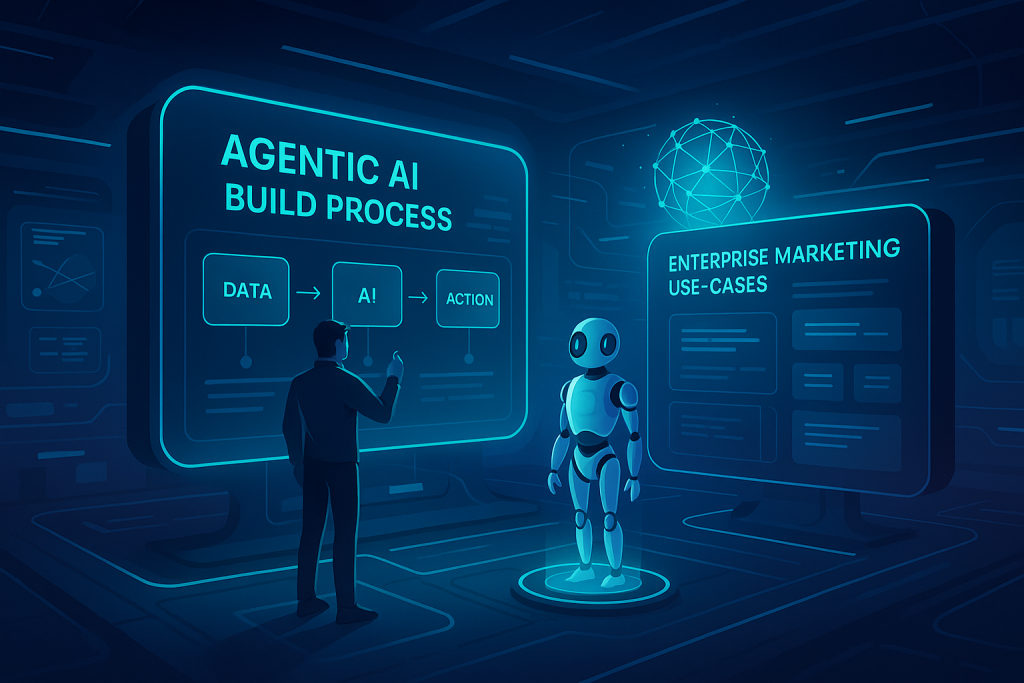
AI Agents: Build Process
Here is a 5 step approach to build AI Agents from the scratch.
- Understand and prioritize the impactful business use-cases
- Design high-level architecture that is secure and scalable
- Apply autonomous behaviour to the AI Agents
- Integrate AI Agents with the existing MarTech eco-system
- Monitor, evaluate, and scale the solutions to accommodate roadmap use-cases and optimize for better performance and reliability
Step 1: Define Impactful Use-Cases
In this step the goal is to identify high-value marketing workflows where AI agents can drive tangible business improvements in performance, personalization, and productivity.
This first step in the Enterprise AI Marketing Agents Build Process sets the foundation for success by selecting use cases where autonomous agents can deliver measurable impact.
Below is a detailed breakdown of sample enterprise marketing use-cases with an indicative agent role and key metrics to focus on.
Use Case | Agent Role | Key Metric Improvements |
Lead Scoring & Nurturing | Prioritize leads based on intent and engagement; trigger timely workflows | Increased Conversion Rate Decreased Cost/Lead |
Content Personalization | Dynamically adapt and serve content based on user profile and behavior | Increased CTR (Click-Through Rate) Increased Engagement Time |
Ad Spend Optimization | Run A/B testing, adjust bids in real-time based on performance data | Increased ROAS (Return on Ad Spend) Decreased CPA (Cost Per Acquisition) |
Customer Retention Campaigns | Detect churn signals; recommend or trigger retention offers or journeys | Increased Retention Rate |
Multi-channel Campaign Execution | Coordinate and schedule messaging across email, SMS, social, and push | Increased Consistency Increased ROI |
Performance Analytics & Reporting | Auto-generate insights from dashboards; reduce manual reporting effort | Decreased Manual Workload Increased Decision Speed |
Why does it matter?
- Strategic alignment: Focuses on outcomes that align with business KPIs.
- Agent-specific behaviors: Helps map capabilities like classification, orchestration, recommendation, and reporting to roles.
- Metric-driven: Sets the stage for objective evaluation and optimization in later stages.
Below are the few tips for you to get started on identifying the key use-cases:
- Start with pain points in your marketing operations or bottlenecks.
- Align with your data maturity: Choose use cases where you already have sufficient data to fuel the agent.
- Quantify impact potential: Use existing KPIs to forecast how automation or intelligence could improve outcomes.
- Prioritize reusability and scale: Select use cases that can be replicated across products, geographies, or campaigns.
Step 2: Design Architecture for Agentic AI Marketing Systems
Define a scalable and modular system architecture to implement autonomous AI agents that integrate with your Martech stack and deliver intelligent actions.
This step focuses on designing the technical architecture required to support the lifecycle of AI agents: from perception and reasoning to action and learning within enterprise marketing ecosystems.
Here’s a layer-wise breakdown of the Agentic AI Design Architecture.
Layer | Description | Sample Tech Stack |
Front-end | User interfaces and reporting dashboards to interact with and monitor agents. | Notion, Slack, CRM Dashboards |
Workflow Engine | Orchestrates sequences of actions and tasks across agents and services. | AWS Step Functions, Azure Durable Functions, Logic Apps |
Communication Bus | Enables event-driven messaging and coordination between services and agents. | AWS EventBridge, Google Pub/Sub, Azure Event Grid |
Model Layer | Hosts foundation models, fine-tuned models, and inference APIs. | OpenAI, Azure OpenAI, Vertex AI, SageMaker |
Agent Logic | Encodes autonomous behavior, tools usage, goal decomposition, memory, etc. | LangChain, AutoGen, custom Python logic |
Data Layer | Stores and serves structured/unstructured data for context and decision-making. | BigQuery, Snowflake, Azure Data Lake |
Design Considerations:
Ensure when you design Agentic MarTech systems, below things are to be taken care of.
- Modularity: Each layer should be loosely coupled to allow changes in tools (e.g., switching from Azure OpenAI to Vertex AI).
- Composability: Use frameworks like LangChain/AutoGen to support multiple tools, memory, and multi-agent collaboration.
- Event-Driven: Adopt communication buses like EventBridge to build scalable, reactive agent architectures.
- Explainability: Use front-end dashboards to expose reasoning, status, and decisions to business users and analysts.
Example flow:
Here is an example flow for Ad Spend Optimization Marketing AI Agent.
- Input Data: Daily campaign data ingested into BigQuery
- Trigger: Anomalous performance triggers EventBridge
- Workflow: Orchestration logic in Step Functions evaluates Ad KPIs
- Model Call: OpenAI analyzes performance narrative; recommends bid strategy
- Agent Logic: Written in LangChain, the agent decides whether to pause or optimize
- Action: Sends a message via Slack or updates CRM dashboard
- Feedback: Logged for human review and future fine-tuning
Step 3: Autonomous Behavior – Making AI Agents Act Independently
In this step, you enable your AI agent to function in a continuous, self-governing loop where it observes its environment, reasons over data, takes actions in align with the goals, and learns from the outcomes with minimum or no human intervention.
A typical AI agent design with closed-loop system inspired by the OODA loop could be used here that broken into four core stages: Observe, Think, Act, Learn.
Core Components of Autonomous Behavior
- Observe
- Purpose: Continuously monitor the environment (CRM, CDP, analytics tools, etc.) to detect relevant signals or events.
- Example: Track customer behavior in real-time – login frequency, purchase drop-off, sentiment, or support queries.
- Data Sources: CRM (Salesforce, HubSpot), Adobe Experience Platform, telemetry APIs, webhooks.
- Think
- Purpose: Analyze the observed data to infer insights or decisions using AI models.
- Example: Apply an ML model to calculate churn probability or segment customers based on intent.
- Tools: OpenAI, Vertex AI, SageMaker, Azure OpenAI, real-time scoring services.
- Act
- Purpose: Take an automated, contextual action based on the inference/decision.
- Example: Launch a win-back email or SMS campaign via Adobe Journey Optimizer, or pause ads for dormant users.
- Integration Points: Marketing automation tools, ad platforms, CMS, or API-based actions (e.g., trigger Logic App).
- Learn
- Purpose: Evaluate outcomes of the action, measure performance, and refine future strategy.
- Example: Analyze open rates, conversion uplift, customer re-engagement, and feed insights into the agent’s memory or logic.
- Tools: Adobe Customer Journey Analytics, Looker, Snowflake dashboards, playbooks, or fine-tuning data.
Example: Churn prevention agent – autonomous behavior loop in action
Observe: CRM shows drop in product usage for a set of customers
Think: ML model predicts 75% churn probability
Act: Agent launches personalized “We miss you!” offer via Adobe Journey Optimizer
Learn: Campaign achieves 18% reactivation; strategy added to re-engagement playbook
Why do we need this step in build process of Agentic MarTech?
- Reduces manual overhead: Automates repetitive and data-driven tasks.
- Improves response time: Agents can take near real-time actions based on live data.
- Self-improves: The learning loop ensures agents become smarter over time.
- Scales decision-making: Agents can operate on large data volumes without burning out.
Step 4: MarTech Integration – Connecting Autonomous Agents with Enterprise Marketing Stack
Enable the AI Agent to communicate with and control various MarTech systems to execute intelligent, data-driven marketing actions at scale.
The diagram depicts how the AI Agent interacts with the Enterprise MarTech Stack using three core architectural layers:
Agent Logic Layer
- Implements the goal-plan-act-learn cycle.
- Responsible for:
- Receiving input signals or goals (e.g., “Reduce churn”)
- Making decisions using inference (via model layer)
- Triggering events or API calls to downstream systems (e.g., send email, update segment)
- Data Layer
- Consists of data warehouses like BigQuery and Snowflake.
- Supplies historical, profile, and behavioral data to the AI agent for decision-making.
- This is where identity resolution, audience creation, and ML feature stores reside.
- Communication Control Layer
- Acts as a communication bus, handling real-time signals using tools like:
- Amazon EventBridge
- Google Pub/Sub
- Azure Event Grid
- Translates agent outputs into events, API calls, or SDK interactions that external systems understand.
- Enterprise MarTech Stack
This is where real execution and marketing delivery happens. The AI agent integrates with:
Capability | Platforms |
CRM | HubSpot, Salesforce CRM – For 1:1 engagement, lead data, and contact sync. |
CDP | Adobe Experience Platform (AEP), Salesforce Data Cloud – For real-time profiles and segmentation. |
Email & Campaigns | Marketo, Mailchimp, Adobe Campaign, Adobe Journey Optimizer – To trigger omnichannel outreach. |
Analytics | Google Analytics 4 (GA4), Looker, Power BI, Adobe CJA – To feed back engagement insights. |
Ads | Google Ads, Meta Ads Manager – For paid media activation, suppression, and retargeting. |
Data & Control Flow
- Input (e.g., new product drop-off pattern or churn risk detected)
- Agent Logic plans a response (e.g., reactivation campaign)
- Inference is made (e.g., best offer for the user)
- Events are triggered (e.g., update audience in CDP, push to AJO or Marketo)
- APIs/SDKs execute the action across CRM, campaign tools, or ad platforms
- Analytics systems measure the outcome
- Learn loop updates agent logic/playbooks
Below are some of the design decisions you could think of while building ai agents for enterprise marketing use-cases:
- Standardize APIs and SDKs across platforms for consistent control.
- Use low-latency communication tools (like EventBridge or Pub/Sub) for real-time responsiveness.
- Ensure data governance and security when the agent accesses or updates sensitive systems.
- Add observability (logs, metrics, and alerts) at integration points to trace failures or misfires.
Step 5: Monitor, Evaluate & Scale – Operationalizing Autonomous Marketing Agents
This final step is all about making the autonomous marketing agent production-ready and performance-optimized. You move beyond setup and integration to a state of continuous performance management and scalable deployment.
Ensure you measure the KPIs to know how much progress you have made in achieving the digital marketing goals.
Metric | What It Measures | Why It Matters |
Conversion Lift | % increase in leads/sales after agent action | Quantifies business impact of agent-driven engagement or personalization. |
Engagement Time | Average time users spend engaging with a site or content | Indicates user interest and relevance of the experience curated by the agent. |
Retention Rate | % of users/customers returning over a given time frame | Measures long-term success in keeping audiences engaged through agent actions. |
CPA / ROAS | Cost per acquisition / return on ad spend | Assesses the cost-effectiveness of agent-initiated campaigns or ad targeting. |
Agent Autonomy Score | % of tasks completed without human intervention | Tracks maturity of the agent—how independently and accurately it performs tasks. |
Some of the operation tools that you may consider to use are:
Function | Suggested Tools |
Dashboards | Power BI, Looker, Google Data Studio, Adobe CJA |
Logs & Traces | Datadog, AWS CloudWatch, OpenTelemetry |
Alerting & Monitoring | Grafana, New Relic, Adobe Assurance, Azure Monitor |
Agent Observability | Custom telemetry + LangGraph, CrewAI, or orchestration-level tracking |
Monitoring isn’t just about detecting errors — it’s about driving intelligent scale. With the right KPIs and tooling, you ensure your agent continuously learns, improves, and delivers increasing value across your marketing stack.
Agentic AI: Implementation Methods
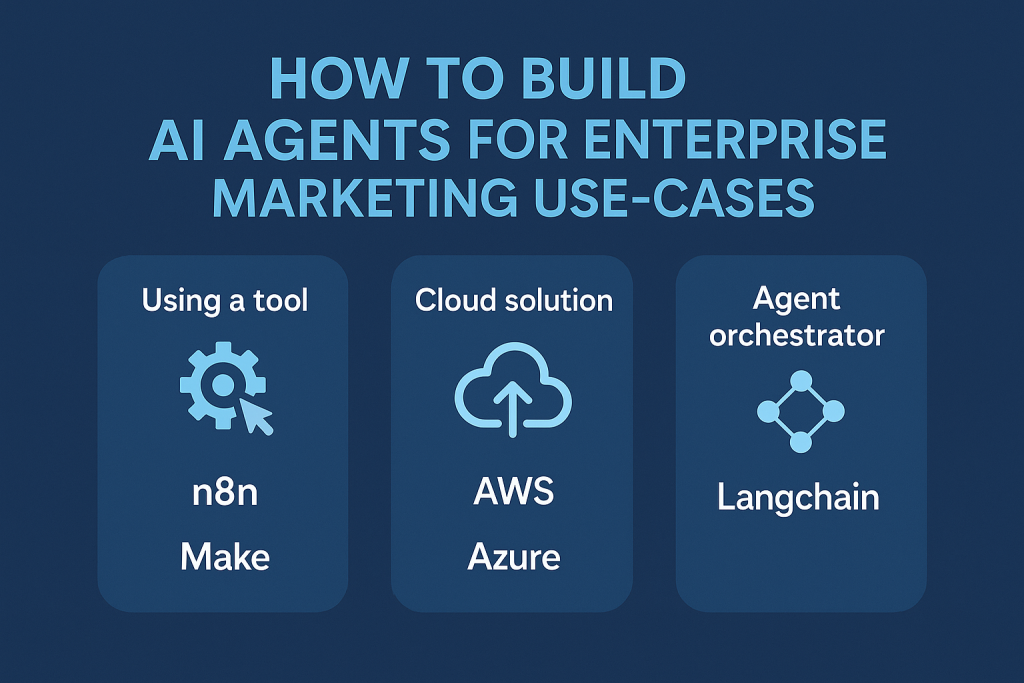
There are 3 main ways to utilize AI Agents for your marketing strategies: Build, Use, or Configure.
Here is a comprehensive comparative framework to help enterprises decide how to integrate AI Agents into their existing MarTech (Marketing Technology) Stack.
- Custom Build AI Agents (using Agent Orchestrator Frameworks like LangGraph, CrewAI)
- SaaS Application: AI Agents (like Adobe Agent Orchestrator, Salesforce Agentforce)
- Cloud Based AI Agents (built using AWS, Azure, or GCP services)
Feature | Custom Build AI Agents | SaaS AI Agents | Cloud Based AI Agents |
Custom Logic | Full control over agent behavior, memory, planning, and orchestration. Ideal for advanced use cases. | Limited to platform capabilities (e.g., prompt templates, workflows). | Highly customizable via serverless functions or orchestration services. |
Enterprise Integration | Manual API calls, webhooks, and custom connectors. Time-consuming setup. | Native to ecosystem (e.g., Adobe RTCDP, Salesforce Data Cloud). | Flexible APIs and SDKs for integration (e.g., Adobe AEP, CRMs, CDPs). |
Multi-Agent Support | Supported using LangGraph, CrewAI for autonomous task orchestration. | Typically single-agent; limited agent interaction. | Possible with custom architecture (e.g., AWS Step Functions, Azure Durable Functions). |
No-code / Low-code | Developer-driven full-code solution. | Yes — drag-and-drop UI and low-code interface (e.g., Adobe Journey AI Assistants). | Partial — supported via Azure Logic Apps or AWS Step Functions. |
Scalability | Manual infra setup needed (e.g., Docker, Kubernetes). | Auto-scaled by SaaS provider. | High scalability via cloud-native infrastructure (e.g., Lambda, Azure Functions). |
Observability & Ops | Manual setup of logs, monitoring, and alerting. | Built-in dashboards and governance features. | Cloud-native tools for monitoring (e.g., CloudWatch, Azure Monitor). |
Ideal For | Developers, Solution Architects, AI Researchers. | Marketing & CRM teams seeking rapid deployment and ease of use. | Enterprise IT & ML teams needing scalable, customizable infrastructure. |
Agentic MarTech: Security, Compliance, and Governance
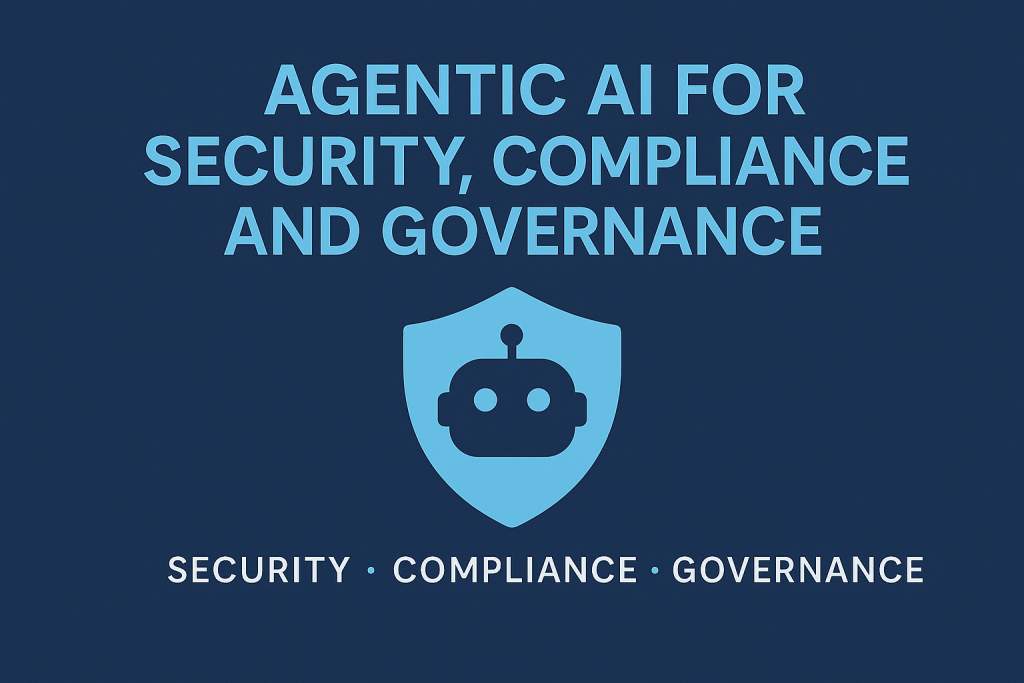
The diagram outlines a layered security architecture for Agentic MarTech autonomous systems, ensuring ethical, secure, and compliant AI agent operations. Here’s a breakdown:
- Security Foundation Layer
Forms the base to protect infrastructure, data, and agent behavior:
- IAM & Secrets Management: Controls agent access to services and data using least privilege principles and secure credential storage (e.g., Azure Key Vault, AWS IAM).
- Encrypted Communications: Ensures data-in-transit and data-at-rest encryption using TLS and KMS.
- Secure Runtime & Dependency Scanning: Protects agents from vulnerabilities by scanning for outdated libraries, sandboxing execution, and validating supply chain integrity.
- Compliance Management Layer
Aligns agent behavior with legal and organizational requirements:
- Consent & Data Usage Control: Implements GDPR/CCPA consent handling and ensures agents only access approved data segments.
- License & Vendor Compliance: Manages third-party tools and libraries for license adherence and contractual obligations.
- Logging, Monitoring & Audit Trails: Tracks agent decisions, failures, and interactions for post-event investigations and compliance reporting.
- Agent Governance & Policy Layer
Enforces organizational rules and ensures agent accountability:
- Agent Registry & Versioning: Catalogs agent versions, changes, and metadata for traceability and rollback.
- Policy Engines (e.g., OPA): Injects runtime business or regulatory policies (e.g., no customer outreach after 9 PM).
- Decision Auditing & Explainability: Captures rationale behind agent actions using structured logs or LLM tracebacks for transparency and review.
- Human Oversight & Ethics
Safeguards responsible AI use:
- HITL Checkpoints: Human-in-the-loop approval for sensitive actions like price overrides or major campaign shifts.
- AI Ethics Reviews: Periodic audits to prevent bias, misuse, or ethical violations in agent logic.
- Agent Override & Rollback Mechanism: Allows manual deactivation or rollback if agents behave unpredictably or harmfully.
This architecture ensures agentic autonomy is balanced with governance, compliance, and human accountability — critical for trust in enterprise marketing environments.
How It All Works Together
Each layer builds on the one below it:
- The Security Layer protects systems.
- The Compliance Layer ensures lawful operations.
- The Governance Layer manages decision-making guardrails.
- The Ethics Layer enforces human control and responsible AI use.
Together, they form a robust, layered defense and accountability model for deploying AI agents safely and ethically in MarTech ecosystems (e.g., Adobe Experience Platform, Salesforce Data Cloud).
Ideal Use Cases for This Architecture
- Autonomous campaign optimization
- Personalized content generation at scale
- Real-time customer journey orchestration
- AI-based segmentation and targeting using RTCDP
Agentic AI and AI Agents: Learning Curve
Below is your comprehensive learning curve from a beginner to advanced level for building ai agents and agentic ai for enterprise martech use-cases.
Phase 1: Foundation (Beginner) – 0–2 months
Concepts
- Basics of AI, ML, and Generative AI
- Intro to Agents vs Agentic AI (autonomy, memory, planning)
- Digital Marketing Fundamentals (Channels, Funnels, KPIs)
Skills to Learn
- Python (basics + libraries: requests, pandas, openai)
- Prompt engineering
- REST APIs & Webhooks
- JSON, YAML, OAuth2
Tools & Platforms
- ChatGPT / Claude
- Zapier / Make.com (low-code integrations)
- Google Tag Manager, Google Analytics
Milestone
- Build your first agent using Make.com to auto-respond to form submissions using GPT
- Publish a marketing blog post using AI-generated content
Phase 2: Applied Practice (Intermediate) – 3–6 months
Concepts
- AI Agent Architecture: Tools, Memory, Planning, Orchestration
- Agent Frameworks: CrewAI, LangGraph, AutoGen
- Data Layer: Real-Time CDPs (Adobe RTCDP, Salesforce Data Cloud)
- Webhooks & Event-driven design
Skills to Learn
- LangChain / LangGraph
- Fine-tuning vs Prompt tuning
- Multi-agent workflows (task decomposition)
- Retrieval-Augmented Generation (RAG)
🛠️ Tools & Platforms
- Azure OpenAI / AWS Bedrock
- Adobe Experience Platform (RTCDP, AJO, Target)
- CrewAI / LangGraph
- GitHub, VS Code
Milestone
- Build a multi-agent system that personalizes emails using Adobe RTCDP segments
- Connect to AJO to trigger journeys based on churn prediction
Phase 3: Enterprise Integration (Advanced) – 6–12 months
Concepts
- Orchestration Patterns (Step Functions / Azure Logic Apps)
- Real-Time Data Activation
- Identity Stitching & Profile Unification
- Personalization at Scale
- Governance & Compliance (PII, consent)
Skills to Learn
- AWS Lambda, Azure Functions, EventBridge, Kinesis/Event Hub
- Adobe Analytics Workspace & CJA
- Adobe Target APIs
- CI/CD pipelines (GitHub Actions, Terraform basics)
Tools & Platforms
- AEP + Azure Event Hub Integration
- IBM watsonx.ai (for enterprise governance)
- Marketing automation tools (Braze, Iterable, etc.)
Milestone
- Deploy a churn prediction agent with real-time segment sync to AEP
- Activate personalized offers via AJO using agent output
Phase 4: Governance, Security & Autonomous Systems (Expert) – 12+ months
Concepts
- Human-in-the-loop (HITL)
- Explainability, Auditing, Ethics
- Secure Agentic AI (Runtime, IAM, Compliance)
- Autonomous goal-based agent workflows
Skills to Learn
- Secure AgentOps design patterns
- Policy engines (OPA), encryption, and tokenization
- ML Ops for Agent retraining and monitoring
- Building with SLAs, DR, and HA (Highly Available agents)
Tools & Platforms
- CrewAI + LangGraph (enterprise use)
- Azure Monitor / CloudWatch
- OPA + IAM + Secure API Gateway
- Adobe Privacy & Security Shield
Milestone
- Build a compliant, observable multi-agent system that autonomously:
- Segments users
- Plans personalized journeys
- Generates & delivers content
- Audits its own decisions
Suggested Learning Resources
Area | Resource |
Python + APIs | Codecademy, RealPython |
Prompting + GPT | OpenAI Cookbook |
LangChain / CrewAI | LangChain docs, CrewAI GitHub |
Adobe Experience Platform | Adobe Learning Center, AEP Tutorials |
Marketing AI Concepts | “AI for Marketers” by Christopher Penn |
Governance & Security | Cloud security whitepapers (AWS, Azure) |
Here is your personalized learning tracks for you to quickly upskill on Agentic AI and become a part of Agentic AI MarTech family.
Agentic AI and AI Agents: Personalized Learnings
If you are a quick learner, who would like to get started on the Agentic MarTech Journey and upskill yourself in just 3 months, below you can download the guide.
If you are a someone who have enough time to grasp all the concepts and upskill yourself within next 6-months, here is the agentic ai martech guide for you to download.
If you are someone who have enough time to start from zero and would like to advance your career to champion AI Agents and Agentic MarTech, here is your ready reckoner.