


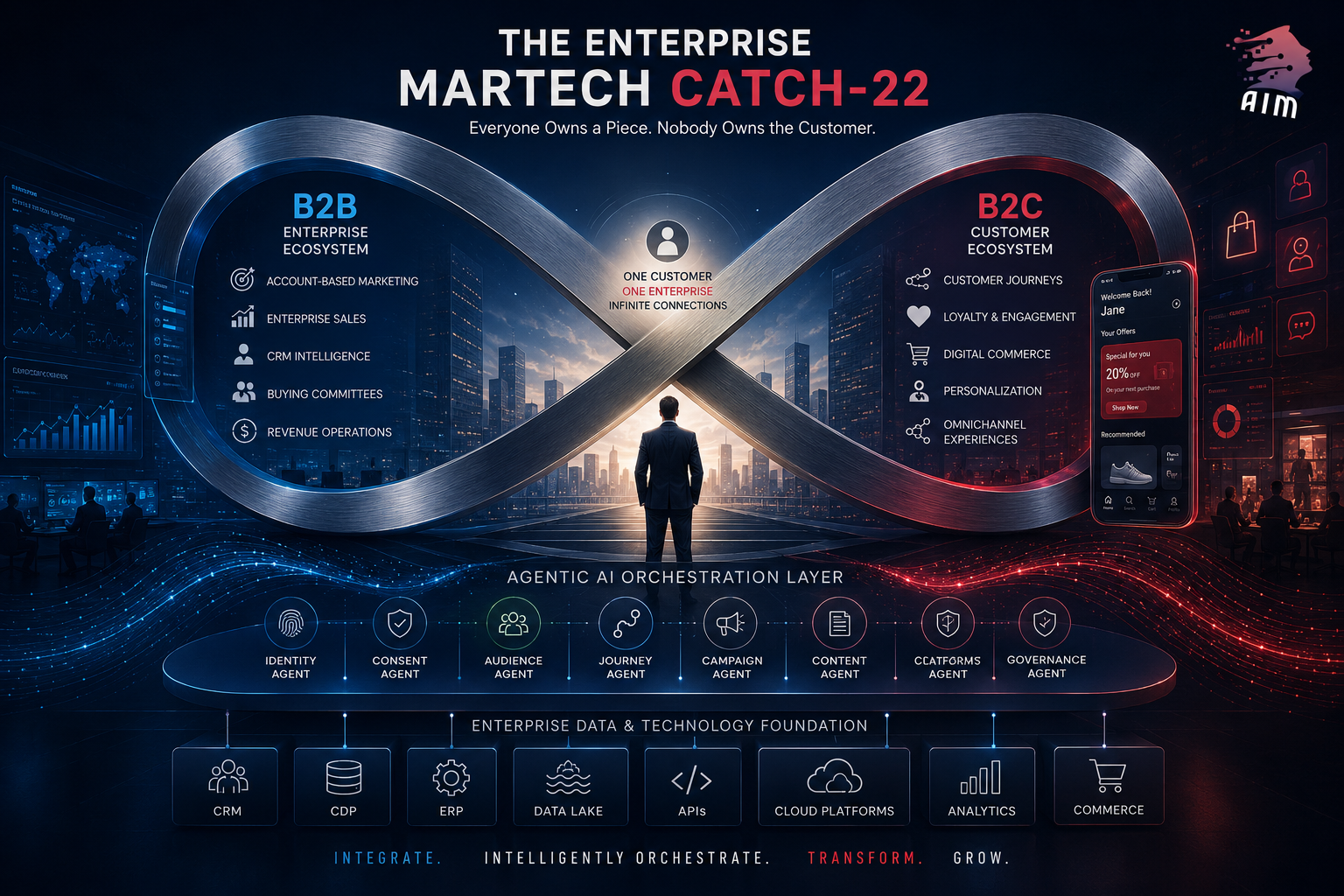
“There was only one catch and that was Catch-22, which specified that a concern for one’s safety in the face of dangers that were real and immediate was the process of a rational mind.” — Joseph Heller, Catch-22
Joseph Heller wrote those words about a World War II bureaucracy that trapped rational people in irrational systems. Decades later, the same paradox plays out every day inside enterprise marketing technology stacks — and it is costing organisations billions.
Here is the modern enterprise version of Catch-22:
Every business unit is optimising for its own goals. The more each team optimises locally, the harder it becomes to optimise globally. And because every team is doing the right thing for their function, no one is doing the right thing for the customer.
This is not a technology problem. It is not a data problem. It is a systemic paradox — and understanding it is the first step to escaping it.
The Scale of the Problem: Why This Matters Now
Let us start with the numbers, because they are sobering.
Digital transformation is failing at industrial scale.
- 70% of digital transformation initiatives still fail to meet their objectives in 2026, despite global spend projected to reach $3.4 trillion (Gartner, 2026).
- Bain’s 2024 study found 88% of business transformations fail to achieve their original ambitions.
- BCG’s analysis of 850+ companies found only 35% reach their stated goals.
- The cost of failed transformation? An estimated $2.3 trillion per year — wasted.
MarTech specifically is in crisis.
- There are now 14,106 unique MarTech solutions available — a 27.8% increase in a single year (State of Martech 2024, chiefmartec.com).
- The average organisation uses 75 different MarTech tools, yet two-thirds of marketers use 16 or more tools for overlapping functions.
- Despite this proliferation, Gartner’s CMO Survey found MarTech utilisation has collapsed to 33% — down from 58% in 2020.
- 54.9% of CMOs report disappointment in their MarTech’s payoff — a 6%+ increase in just one year (CMO Survey, 2024).
- 60% of MarTech initiatives fail to deliver expected ROI.
And the core ambition — a 360-degree customer view — remains largely a myth.
- 80% of organisations aspire to a unified customer view.
- Yet most still battle fragmented data, siloed systems, and inconsistent records.
- 43% of companies struggle to maintain accurate, real-time customer data.
- Only 29% of enterprise applications are integrated — despite organisations averaging 897 applications (MuleSoft Connectivity Benchmark, 2025).
So what is going wrong?
Anatomy of the Catch-22: Four Ecosystems, One Customer
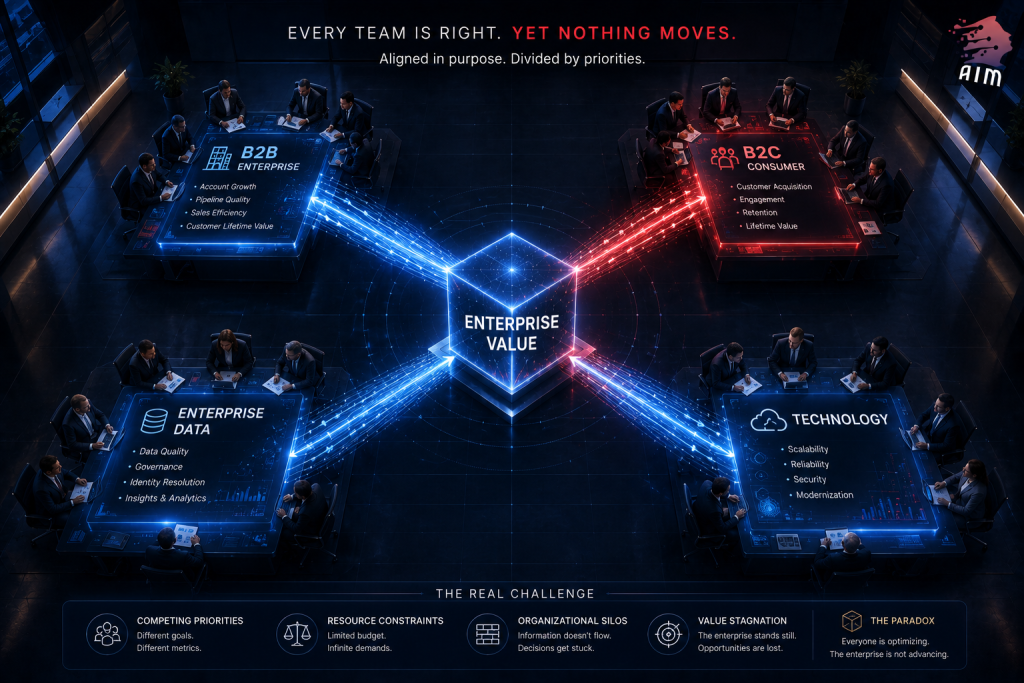
Inside a typical large enterprise, there are not one or two data ecosystems. There are four distinct operating worlds — each with their own priorities, their own tooling, their own definition of the customer, and their own definition of success.
The B2B Business World
Account executives, sales ops, and demand generation teams live here. They care about:
- Lead quality and Marketing Qualified Lead (MQL) conversion
- Account intelligence and buying committee mapping
- Sales velocity and pipeline coverage
- Revenue attribution and ROI
Their tooling: Salesforce, Marketo, 6sense, Outreach, LinkedIn Sales Navigator.
Their customer is an account — a company, a decision-making unit, a pipeline stage.
The B2C Business World
Brand marketers, loyalty managers, and CRM teams live here. They care about:
- Personalisation and next-best-offer
- Customer journeys and lifecycle engagement
- Loyalty programme performance
- Net Promoter Score (NPS) and Customer Lifetime Value (CLV)
Their tooling: Adobe Journey Optimizer, Salesforce Marketing Cloud, Braze, Klaviyo, Attentive.
Their customer is an individual — a consumer profile, a segment, a cohort.
The Enterprise Data World
Data engineers, data governance leads, and CDOs live here. They care about:
- Identity resolution and golden record management
- Data quality, lineage, and completeness
- Privacy compliance (GDPR, CCPA, PDPA)
- Regulatory audit trails
Their tooling: Informatica, Databricks, Snowflake, Apache Kafka, Collibra.
Their customer is a record — a unique identifier, a consent flag, a schema.
The Enterprise Technology World
Enterprise architects, platform engineers, and CTOs live here. They care about:
- Stable architecture and uptime SLAs
- Reducing technical debt
- Reusable APIs and platform scalability
- Vendor consolidation and total cost of ownership
Their tooling: AWS, Azure, Mulesoft, API gateways, Kubernetes.
Their customer is a system — a service, a data contract, a latency SLA.
All four worlds are rational. All four worlds are in conflict.
The Catch-22 Matrix: Where Every Good Decision Blocks Another
| Team | What They Want | What They Unintentionally Create |
| B2B | More lead data, richer account signals | More duplicate identities, data quality debt |
| B2C | Faster personalisation, more channel activation | More fragmented customer profiles |
| Data | Strong governance, clean data | Slower business execution, “data jail” |
| Technology | Standardisation, platform stability | Reduced business flexibility, slower innovation |
The result is perfectly described by the paradox within the paradox:
Marketing says: “I can’t personalise because the data isn’t clean.”
Data says: “We can’t clean data because marketing keeps generating duplicates.”
IT says: “We can’t integrate because requirements keep changing.”
Business says: “We need results this quarter.”
Nobody is wrong. Nobody can move.
This is the Catch-22.
The Identity Crisis at the Core
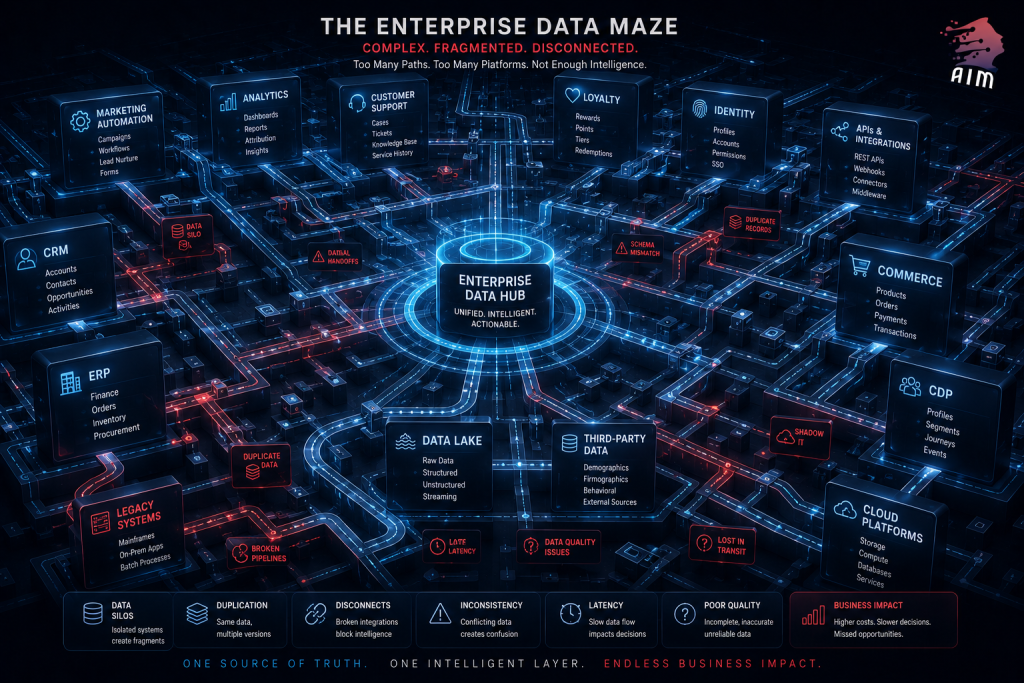
Beneath the organisational conflict sits a deeper technical crisis: the customer exists in ten places simultaneously, and no one is responsible for reconciling them.
Consider a typical enterprise customer journey in a B2B2C company:
- A prospect engages with an ABM ad → Stored in 6sense/Demandbase as an anonymous account signal.
- They fill in a web form → Stored in Marketo as a lead with an email address.
- They attend a webinar → A second lead record is created in Zoom + Marketo.
- They call sales → A third record is created in Salesforce CRM as a contact.
- They buy → An order is created in the ERP or commerce platform.
- They log into the customer portal → A fourth identity is created in the IAM system.
- They raise a support ticket → A fifth record is created in ServiceNow or Zendesk.
- They join the loyalty programme → A sixth record is created in the loyalty platform.
The same person. Six records. Six systems. Zero shared identity.
Every platform believes it is the “source of truth.” The customer ends up existing in pieces — never whole.
The downstream consequences are severe:
- 85% of companies believe they personalise effectively. Only 60% of customers agree.
- 76% of customers express frustration when personalisation is missing or irrelevant (Contentful, 2025).
- Only 24% of firms effectively achieve omnichannel personalisation — the main obstacles are departmental silos and outdated technology.
- 69% of customers want consistent experiences across physical and digital channels. Almost none receive them (Salesforce/Twilio-Segment).
The gap between what enterprises promise and what customers experience is not a strategy gap. It is a systems architecture gap, rooted in organisational incentive misalignment.
The Data Governance Paradox
Data teams carry an enormous burden that is rarely appreciated.
Since 2018, European regulators have issued over 2,800 GDPR fines totalling more than €6.2 billion. Data breach notifications rose to over 400 per day in 2025 — a 22% year-over-year increase.
Meanwhile:
- 68% of organisations cite data silos as their top concern — up 7% from the previous year (DATAVERSITY, 2024).
- 80% report that data silos are hindering digital transformation (Salesforce Connectivity Benchmark, 2024).
- Knowledge workers spend an average of 12 hours per week “chasing data” across disconnected systems (Forrester Research).
- Only 26% of Chief Data Officers are confident their organisation can use unstructured data in a way that delivers business value (IBM, 2025).
So data teams respond rationally: they build governance walls. They require data quality audits before systems are connected. They enforce consent frameworks before audiences are activated. They mandate architecture review boards before new tools are onboarded.
All of this is correct. All of it slows the business down. And the business pushes back.
The data team is blamed for being a bottleneck. The business is blamed for generating dirty data. The cycle repeats. Nothing changes. This is the governance Catch-22 within the larger Catch-22.
The Technology Integration Nightmare
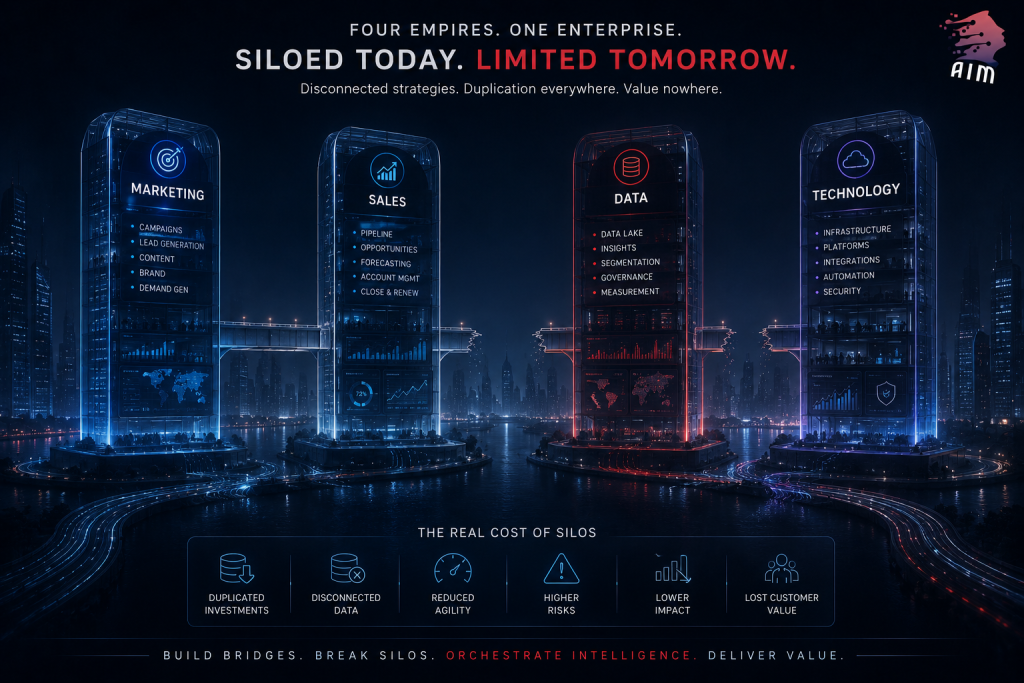
For enterprise technology teams, the problem is integration math that has become unsolvable.
- 84% of all system integration projects fail or partially fail (Integrate.io Research).
- Organizations average 897 applications but only 29% are integrated (MuleSoft 2025).
- ETL data is more than 5 days old by the time it reaches destination systems in two-thirds of pipelines — making “real-time personalisation” a contradiction in terms (Datavail Research).
- Companies with strong integration achieve 10.3x ROI from AI initiatives versus 3.7x for those with poor data connectivity — a 2.8x performance gap that is purely architectural (MuleSoft 2025).
Technology teams know this. They design integration standards and API governance frameworks. But the business — under quarterly pressure — works around them, procures new point solutions, and creates yet more integration debt.
The result: 72% of IT leaders describe their current infrastructure as “overly interdependent,” while 80% say data silos are still blocking digital transformation (Salesforce 2024). Dependent enough to be fragile. Isolated enough to be useless.
Where AI Makes It Worse — Before It Makes It Better
Here is the uncomfortable truth that most AI vendors are not telling you:
Applying AI to a fragmented MarTech ecosystem does not solve fragmentation. It accelerates it.
- 74% of companies show no tangible value from AI investments, despite $252.3 billion in collective AI spending in 2024 (BCG / Stanford HAI, 2025).
- 42% of companies abandoned most AI initiatives by mid-2025 — up from 17% the prior year (S&P Global Market Intelligence, 2025).
- 40%+ of agentic AI projects are predicted to be cancelled by 2027 (Gartner, June 2025).
- Only 19.2% of organisations are deploying AI agents for full end-to-end campaign automation (HubSpot, 2026).
- 83% of marketers say customers now expect two-way conversations, yet they are blocked by disjointed data (Salesforce State of Marketing, 2026).
The pattern is consistent across every major research firm: AI fails when the data foundation is broken. You cannot train a personalisation model on six different, conflicting versions of the same customer. You cannot activate a journey agent if consent signals are not propagated in real time. You cannot govern AI decisions if accountability is scattered across twelve systems.
AI does not fix the Catch-22. It reveals it.
The Breakthrough: Agentic AI as the Coordination Layer
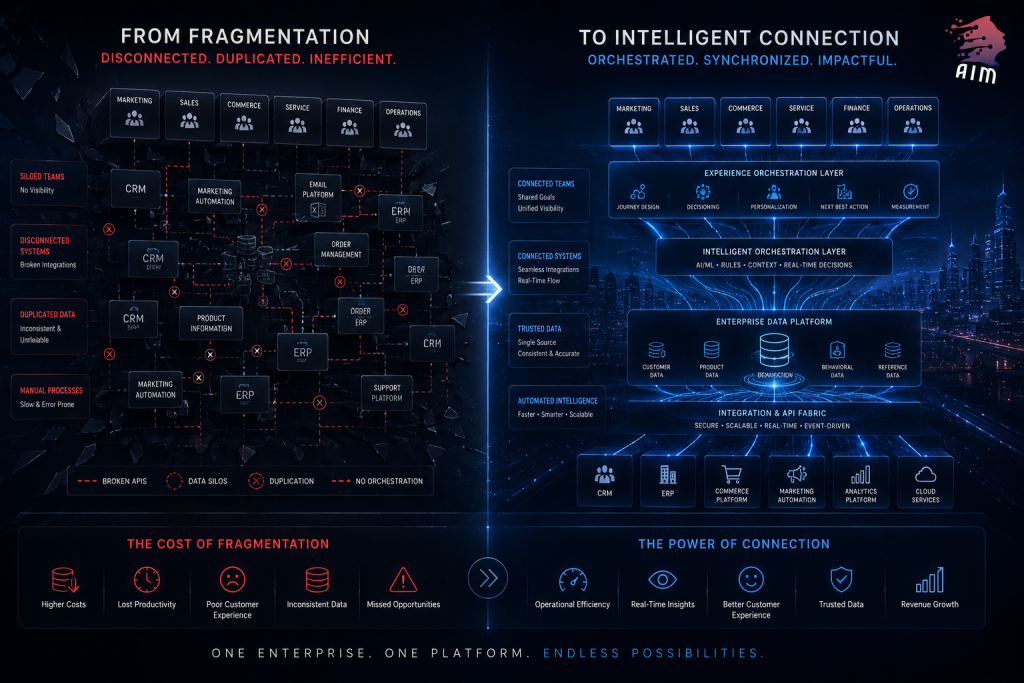
This is where the conversation shifts — and where an entirely new architectural model becomes possible.
The traditional enterprise model tries to solve the Catch-22 by unifying data first — centralising everything into a single platform before activating anything. This approach consistently fails because the enterprise is too large, too politically complex, and too fast-moving to achieve perfect unification before activation.
The emerging model inverts this logic. Instead of centralising data, you coordinate intelligence.
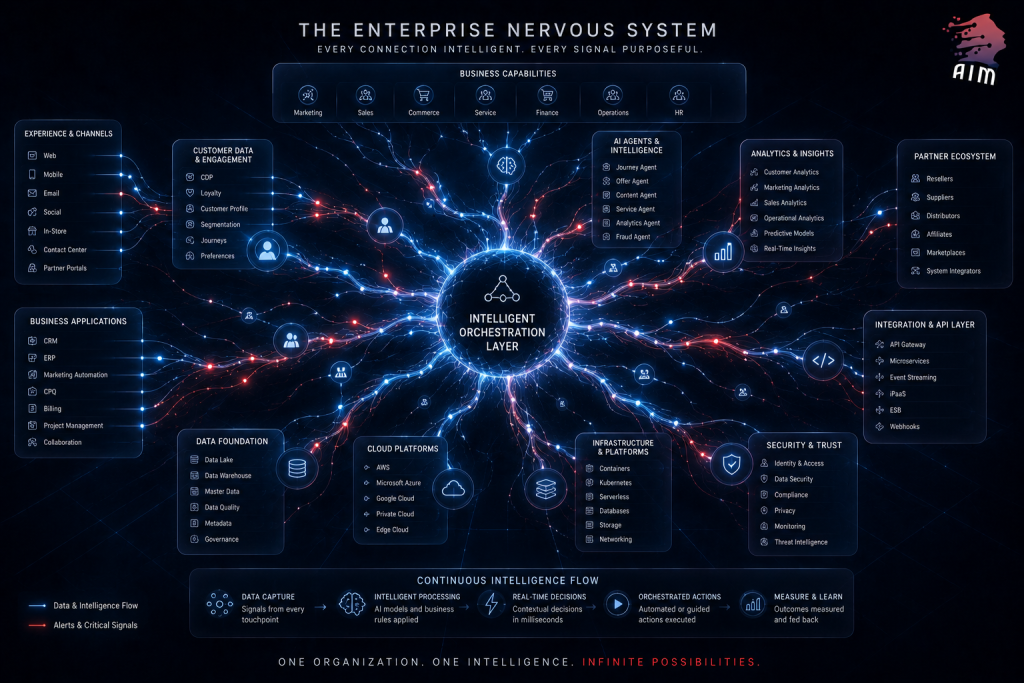
Agentic AI — autonomous AI systems that can perceive context, make decisions, and take actions across systems — offers a fundamentally different resolution to the Catch-22. Rather than making every team agree on a single source of truth, you deploy specialised agents that each own a specific coordination responsibility.
The numbers support this shift:
- 79% of organisations report some level of agentic AI adoption, with 96% planning to expand in 2025.
- Companies report average ROI of 171% from agentic AI, with U.S. enterprises achieving 192% — 3x traditional automation ROI.
- The agentic AI market is growing from $5.25 billion in 2024 to $199 billion by 2034 — a 38-fold increase.
- Gartner predicts 40% of enterprise applications will include task-specific AI agents by end of 2026 (from less than 5% in 2025).
- 88% of adopters achieved positive ROI from agentic AI (Google Cloud Study, 2025).
- By 2028, 68% of customer interactions are expected to be handled by agentic AI.
- Gartner forecasts $15 trillion in B2B purchases will be mediated by AI agents by 2028.
But the key insight is how agents are deployed — not as replacements for people, but as a coordination layer that sits between business intent and technology execution.
The Agent Architecture: Turning Silos into a System
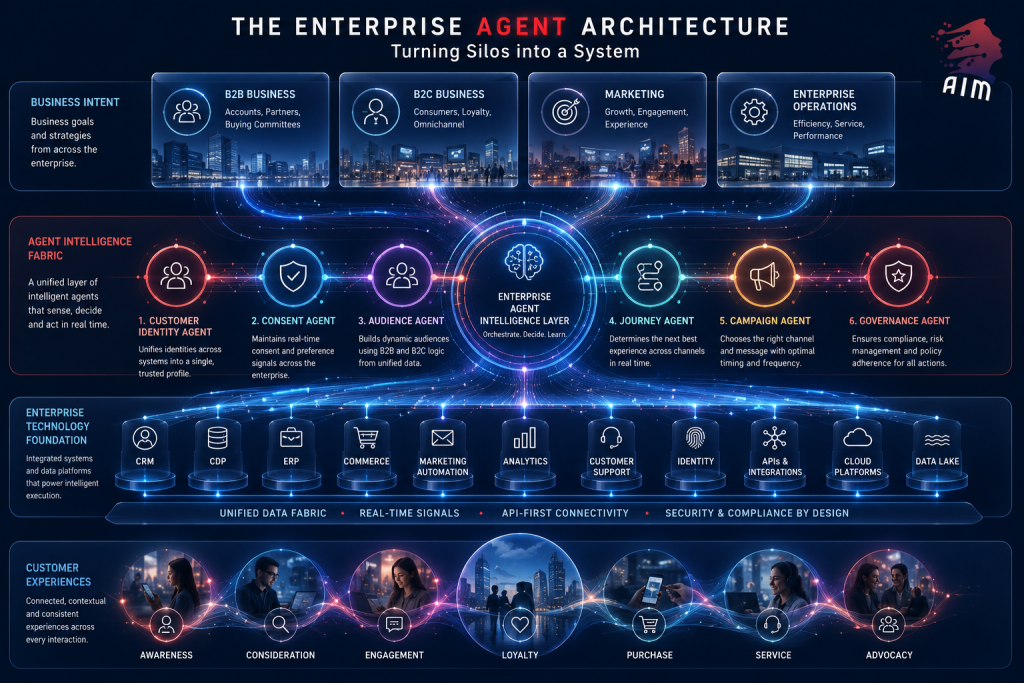
Here is how the agent layer resolves each arm of the Catch-22:
1. Customer Identity Agent
Resolves the “ten records, one person” problem.
This agent continuously monitors identity signals across CRM, CDP, loyalty, commerce, and support systems. It applies probabilistic and deterministic matching rules to create a unified identity graph — without requiring every system to be replaced.
Business impact: Marketing can personalise based on the customer’s full history, not just the slice visible in their tool. Data teams get a governed, auditable identity resolution process. IT gets a reusable service that every platform can query.
2. Consent Agent
Resolves the governance deadlock.
This agent maintains a real-time consent registry. Every time a customer interacts — on web, in-app, through call centre, or via email — the consent agent updates the central record and propagates that signal downstream in milliseconds. No campaign fires. No personalisation executes. No data is transferred without passing through the consent agent first.
Business impact: Marketing moves faster because governance is automated, not manual. Data teams get systematic compliance proof. Legal gets a defensible audit trail.
3. Audience Agent
Resolves the segmentation conflict between B2B and B2C.
B2B wants account-level audiences. B2C wants individual consumer profiles. The audience agent dynamically builds audiences from a unified data layer — applying B2B logic (account scores, intent signals, buying committee coverage) or B2C logic (behavioural segments, lifecycle stage, propensity scores) based on the activation context.
Business impact: Both business lines get the audience logic they need, without competing for the same data team’s sprint capacity.
4. Journey Agent
Resolves the “next best action” paralysis.
When a customer interacts, who decides what to do next? Currently: everyone. Marketing wants to send an email. Sales wants to trigger an outreach. Loyalty wants to deliver a push notification. The result is noise — or worse, silence while teams debate.
The journey agent applies a unified decisioning model — weighted by business priority, consent, channel preference, recency, and predicted value — and determines the next best experience in real time. One decision. Coordinated.
Business impact: Customers receive coherent, contextual experiences. Internal teams stop stepping on each other’s campaigns.
5. Campaign Agent
Resolves the channel selection problem.
Given a segment, a message, and a customer — what channel should fire? Email? SMS? Push? In-app? A sales call? The campaign agent learns from historical engagement data, applies recency and frequency caps, checks consent, and selects the optimal channel. It also monitors performance and reallocates budget dynamically.
Business impact: Marketing achieves measurably higher engagement without increasing send volume. Technology teams get automated channel governance.
6. Governance Agent
The compliance controller for the entire agent layer.
Every action taken by every other agent passes through the governance agent. It checks: Is this consent-valid? Does this violate any data residency rule? Is this customer under a regulatory suppression order? Does this action conflict with any active business policy?
Business impact: The enterprise can deploy AI at scale with confidence. Risk and compliance teams have a single point of governance visibility.
The Architecture That Makes It Real
Here is how the full enterprise architecture looks when the agent layer is introduced:
The agent layer is the missing architectural component in almost every enterprise MarTech stack. It is the translation layer between business intent (what leaders want to achieve) and technology execution (what systems actually do).
Without it, every system optimises in isolation. With it, the ecosystem becomes collaborative.
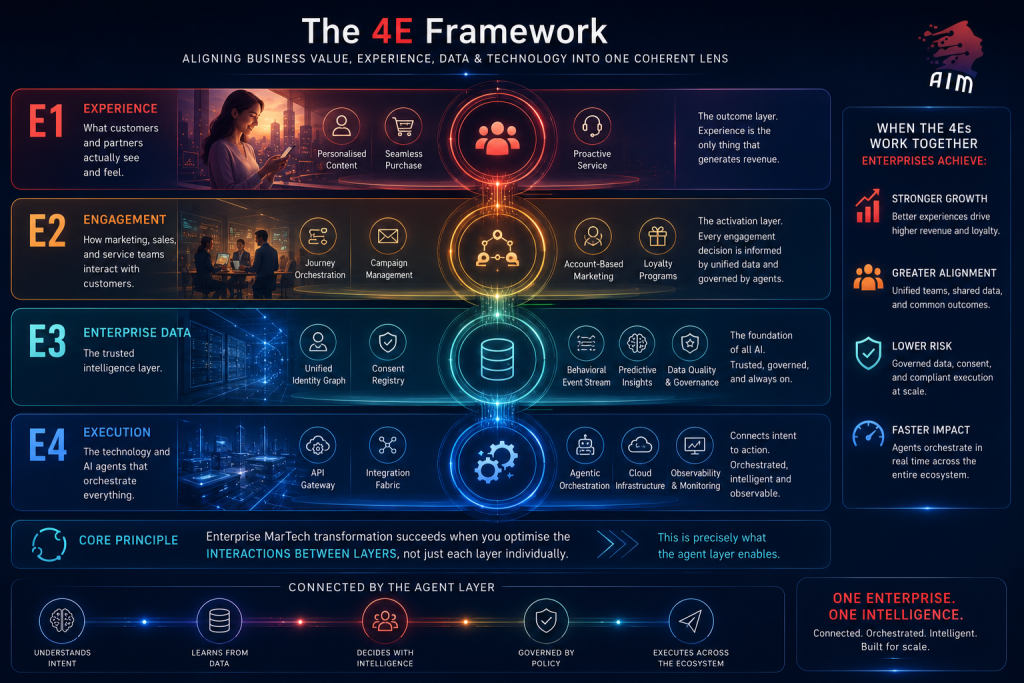
Introducing the 4E Framework
To understand how enterprise MarTech transformation should be designed — rather than just layered — I propose the 4E Framework: a model that aligns business value, customer experience, data strategy, and technology architecture into a single coherent lens.
E1: Experience
What customers and partners actually see and feel.
This is the outcome layer — the personalised email, the relevant content, the seamless purchase, the proactive service interaction. Experience is ultimately the only thing that generates revenue.
Most organisations optimise this layer in isolation, then wonder why their personalisation engine fails. Experience is the output of all four Es working together.
E2: Engagement
How marketing, sales, and service teams interact with customers.
This is the activation layer — journey orchestration, campaign management, account-based marketing, loyalty programme mechanics. Every engagement decision should be informed by unified data and governed by the agent layer.
The fundamental failing in most enterprises: engagement teams are given disconnected tools and told to create connected experiences. They cannot. The tools do not share memory.
E3: Enterprise Data
The trusted intelligence layer.
This is not just a data warehouse. It is the unified identity graph, the consent registry, the behavioural event stream, the predictive model outputs, and the data quality layer that makes everything else trustworthy.
Enterprise Data is the foundation of all AI. It is also the layer most commonly underfunded, under-governed, and under-appreciated — until something breaks.
E4: Execution
The technology and AI agents that orchestrate everything.
This is the layer that connects intent to action. It includes the API gateway, the integration fabric, the agentic orchestration layer, the cloud infrastructure, and the observability platform.
Execution excellence is measured not by the sophistication of individual tools, but by the quality of interactions between layers — how quickly Experience learns from Data, how intelligently Execution governs Engagement, how seamlessly the agent layer coordinates across all four.
The 4E Framework’s core principle: Enterprise MarTech transformation succeeds when you optimise the interactions between layers, not just each layer individually. This is precisely what the agent layer enables.
Real-World Examples: Who Is Getting This Right
Example 1: A Global Bank Breaking the B2B/B2C Catch-22
A major international bank operates both a retail (B2C) banking division and a corporate (B2B) banking division. Each division had built separate CRM, data, and marketing automation stacks over two decades. The same individual — a small business owner — might be a retail banking customer and also a commercial banking prospect, but the two divisions had no shared view.
By deploying an identity agent across both stacks, the bank built a relationship graph that connected the individual’s retail behaviour with their commercial profile. A commercial banker could now see that a prospect had been a loyal retail customer for 11 years — and use that context in their outreach. Personalisation improved. Conversion improved. And the data team finally had a governed identity process that worked for both B2B and B2C simultaneously.
Example 2: A Retail Conglomerate Escaping the Data Governance Deadlock
A retail group with 12 brands across e-commerce, physical stores, and a loyalty programme faced a classic governance deadlock: the data team refused to activate audiences until every source system was cleaned and compliant. Brands were waiting 8–12 weeks for audience segments.
By deploying a consent agent and a governance agent, the team shifted from pre-activation governance (review everything before it goes out) to inline governance (review as execution happens). Audience build times dropped from weeks to hours. Compliance confidence actually increased because every decision had an automated audit trail. The governance deadlock was broken without compromising compliance.
Example 3: A SaaS Company Aligning B2B Intent with B2C Activation
A B2B SaaS company selling to enterprise IT teams discovered that 94% of their prospects were using generative AI tools as part of their buying research before ever speaking to sales. But their marketing automation was built for email-centric demand generation — not for AI-first buyer journeys.
By deploying a journey agent that monitored real-time intent signals from both their website (B2C-style behavioural data) and their CRM accounts (B2B account intelligence), they were able to trigger contextual content, personalised sales alerts, and relevant case studies at the moment of peak buyer intent — not days later when the human marketing ops cycle caught up.
The Uncomfortable Organisational Truth
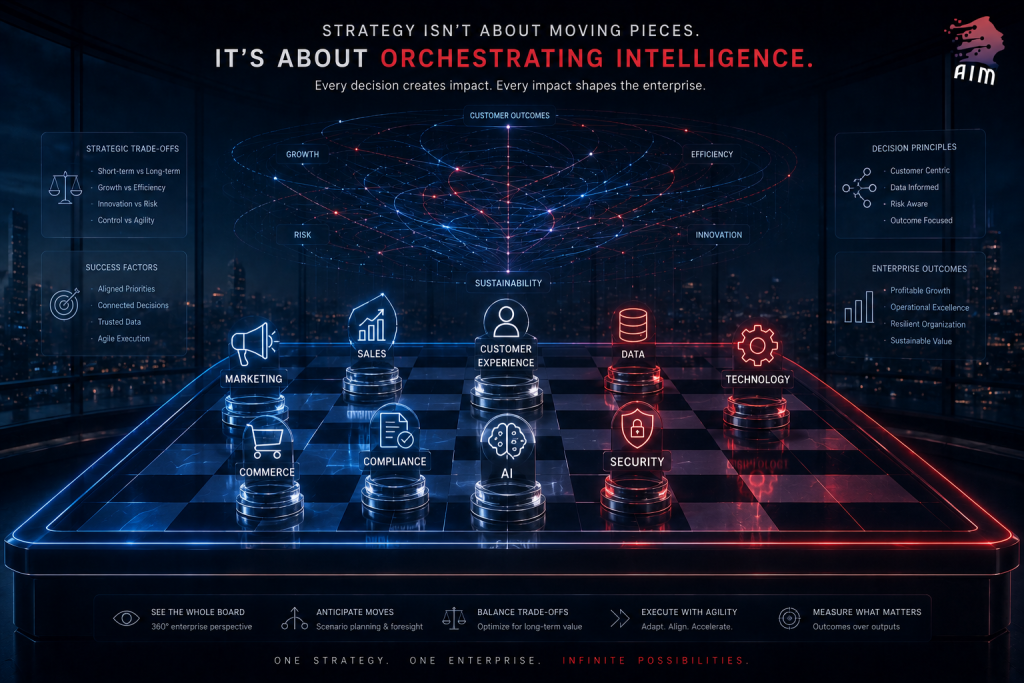
All of this architectural sophistication will fail without one more ingredient: organisational alignment.
The Catch-22 is not just technical. It is political. Every team’s budget, headcount, and bonus structure is tied to local optimisation metrics. B2B gets credit for leads. B2C gets credit for engagement. Data gets credit for data quality scores. Technology gets credit for uptime.
Nobody gets credit for the interactions between teams.
This is why a MarTech transformation that is purely technical — buy a CDP, deploy a journey tool, stand up a data lake — consistently fails to deliver. Technology solves the integration problem. It does not solve the incentive problem.
The enterprises that escape the Catch-22 do three things differently:
- They create a shared accountability metric. Not just leads, not just engagement — but a unified Customer Health Score that all four business units contribute to and are measured against.
- They invest in a MarTech Centre of Excellence (COE). A cross-functional team — with representatives from B2B, B2C, Data, and Technology — that owns the agent layer, governs the data contracts, and arbitrates conflicts between business units.
- They treat the agent layer as product infrastructure, not a project. The identity agent, the consent agent, the journey agent — these are not one-time deliverables. They are living systems that evolve with the business, governed as enterprise-grade products.
The Path Forward: From Catch-22 to Coordination
The enterprise MarTech Catch-22 is real, pervasive, and expensive. But it is not inevitable.
The resolution is not to force every team to agree on a single platform. The enterprise is too complex for that fantasy. The resolution is to build a coordination layer that lets every team keep their tools, their priorities, and their agency — while ensuring that the customer experiences the sum of all those efforts as a single, coherent, intelligent relationship.
That coordination layer is the agentic AI model.
And the organisations that build it now — before their competitors do — will not just escape the Catch-22. They will turn the complexity that currently blocks their rivals into a competitive moat that accelerates their own growth.
Summary: The Key Principles
- The enterprise MarTech Catch-22 is not a technology problem — it is a systemic architecture and incentive problem.
- Four ecosystems (B2B, B2C, Data, Technology) each optimise rationally for local goals, creating collective dysfunction.
- The 360-degree customer view fails because the customer exists as multiple disconnected identities across multiple systems.
- AI applied to a fragmented stack accelerates failure — 74% of companies show no tangible AI value despite massive investment.
- The breakthrough is an agent layer — specialised AI agents that coordinate between business intent and technology execution without requiring a single platform moat.
- The 4E Framework (Experience, Engagement, Enterprise Data, Execution) provides the architectural lens for designing transformation across layers, not within them.
- Organisational alignment — shared metrics, a MarTech COE, and treating agents as product infrastructure — is the non-negotiable human layer that makes the technical layer work.
Sources:
- Gartner CMO Survey, 2024–2026
- Bain & Company Business Transformation Study, 2024
- BCG Digital Transformation Analysis (850+ companies)
- MuleSoft Connectivity Benchmark Report, 2025
- State of Martech 2024 & 2025 — Scott Brinker & Frans Riemersma
- Forrester Research — Knowledge Worker Productivity, 2024
- Adobe 2026 AI and Digital Trends in B2B Journey Orchestration
- IBM Institute for Business Value — CDO Study, 2025
- DATAVERSITY Trends in Data Management, 2024
- Salesforce State of Marketing (10th Edition), 2026
- Salesforce Connectivity Benchmark Report, 2024
- BCG / Stanford HAI AI Investment Study, 2025
- S&P Global Market Intelligence, 2025
- Contentful Personalization Statistics, 2025
- Globe Newswire — Agentic AI Market Forecast
- Google Cloud Agentic AI ROI Study, 2025
- commercetools — AI Agent Commerce Forecast
- CMO Survey Fall 2024 / Spring 2025
